

Roofers in Batheaston
Roof work on the north bank of the Avon, beneath Solsbury Hill and its old Bath stone quarries, in a village that appears in the Domesday Book.
Batheaston at a glance
- Distance
- 29.1 road miles south of Stroud
- Council
- Bath and North East Somerset Council
- Conservation area
- Batheaston
- Listed church
- St John the Baptist, Grade II*
Batheaston's roofs under Solsbury Hill
Batheaston lies on the north bank of the River Avon, about 2 miles east of Bath, with Solsbury Hill rising above it. The hill was an Iron Age hill fort, it overlooks the village from within the Cotswolds National Landscape, and it is littered with former quarries where Bath stone was extracted. That puts the village in a particular position for roof work: a protected landscape on the doorstep, a conservation area in the village itself, and a long record of stone being cut from the ground just above the houses.
The village is old. Domesday Book of 1086 names it Estone and records 48 households. St John the Baptist's church dates from the 12th century and was remodelled in the 15th, when its west tower went up around 1460, and John Pinch the Younger of Bath added a north aisle around 1834. Eagle House is Grade II* listed. Buildings of those ages sit among later houses, so a single road can run from a medieval church to a modern extension.
Stone cut on the hill does not settle what is on a given roof today. We identify the covering on each roof at the survey, from a ladder or from photographs you send, and price what is there. Where the covering is unclear, a photograph taken from the lane is a good start, and we can build on that at the survey.

Hillside of stone terraced houses with mossy stone tile roofs and chimneys 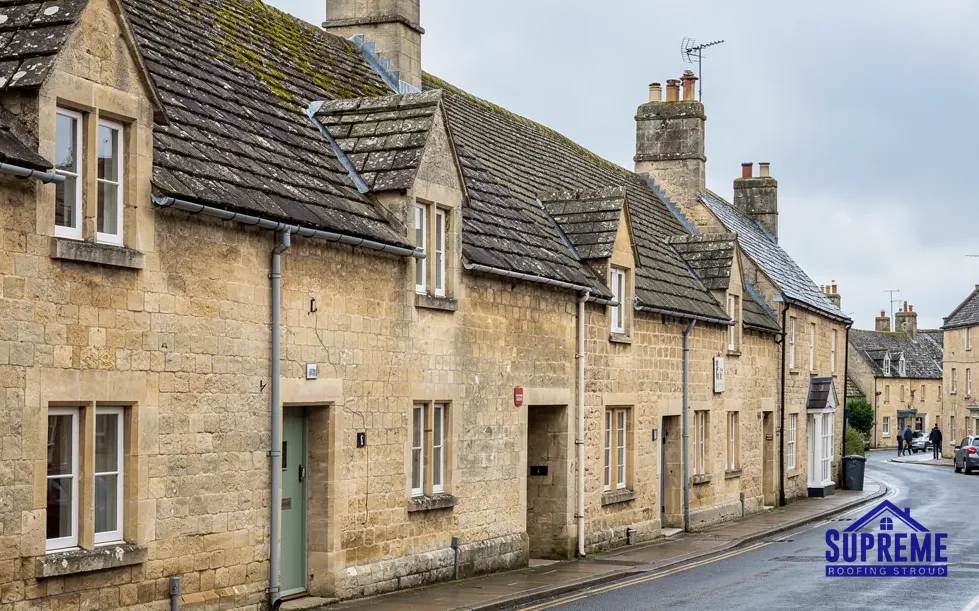
Terrace of stone cottages with dormer windows and stone tile roofs

Chapter 01
Solsbury Hill, the quarries and the Cotswolds National Landscape
Living beside a protected landscape changes what you can alter on a roof, though not what you can repair.
Chapter 01In this chapter
Solsbury Hill overlooks the village from within the Cotswolds National Landscape, the current name for what the law still calls an Area of Outstanding Natural Beauty. That status does not stop anyone mending a roof, and it does not put the National Landscape board in charge of your planning application: that stays with the district council, which for Batheaston is Bath and North East Somerset Council. What the designation does is switch off some of the permitted development rights that apply elsewhere.
In this chapter
The clearest example is the dormer. Roof additions of that kind are not permitted development on land in a conservation area or the National Landscape, so a loft conversion with a dormer here needs a planning application. Cladding the outside of a house is also outside permitted development on that land. Neither rule touches a repair, a like-for-like re-roof or a replacement gutter, which is where most of our work lies in the village. Where a roof window is what you want, our roof windows in conservation areas page covers that route in detail.
Like for like is the phrase that keeps a job simple. If the old roof is slate, the new one is slate, with the same size and laid to the same pattern. If it is stone, the replacement is stone, and the ridge, the verges and the details at the eaves go back as they were. A change of material alters the way a building looks, and then the council needs to be asked, so that conversation happens at the survey, before the quote is written.
Gutters need the same thought on a hillside village. Water that runs off a roof on a slope arrives at the downpipe faster than on level ground, so outlets that look generous can still overflow when leaves or moss collect. We look at the slope of every run, the joints, and whether the downpipe discharges clear of the wall, then list any replacement in the quote. Nothing about this is unusual, but under a hill it is worth doing before the autumn leaves arrive.
Stone from the hill
The former quarries on Solsbury Hill are a reminder that Bath stone has been cut near here for a long time. That matters if a house has a stone roof, stone chimneys or a stone parapet. Stone is heavy, so lifting and laying it takes planning, and the structure underneath must carry it. If you are weighing a lighter covering instead, remember that a covering that is 15 per cent or more heavier brings in Building Regulations approval, and the Planning Portal advises a structural check where the new tile is significantly heavier or lighter.
Our roof replacement page explains how a full strip and re-cover is planned and priced, from scaffold to waste.
Designation restricts what you add to a roof far more than what you mend.
Myth: Being inside a National Landscape means every roof job needs planning permission.
Fact: Like-for-like repairs and re-roofing are not usually development; it is changes such as dormers that lose their permitted development rights.
Chapter 02
St John the Baptist and work at height
A 12th-century church with a fifteenth-century tower shows what roof work on old, tall buildings involves.
Chapter 02In this chapter
St John the Baptist stands as the village church and is Grade II* listed. Its fabric began in the 12th century, it was remodelled in the 15th century, when the four-stage west tower was built, and John Pinch the Younger of Bath added the north aisle around 1834. A tower like that is the village's best reminder that old buildings are altered in stages, and that each stage leaves a join in the roofline.
In this chapter
A church in worship use sits outside listed building consent, and a faculty from the diocese is what permits the roof work. We do not make that decision for anyone, but we are happy to quote the work once the right permission is in place. For a house or a hall nearby that is not in worship use, listed building consent from the council is the route.
Tall buildings bring their own problems, and they apply to any house with a high roof or an awkward gable. Reaching a tower roof, a high parapet or a steep valley is a question of scaffold design before it is a question of roofing. A tower that stands clear of the road may take a free-standing scaffold with a lift for materials. A gable close to a neighbour may need a scaffold that spans a gap. A cherry picker can save cost on a short repair, but only when the ground is firm and level enough to take it. On a sloping verge it often cannot, and the scaffold is the safer choice.
Wind loading on a high roof is a reason to keep loose slates and tiles stacked low and tied down while a section is open. We cover any exposed area with sheeting when we finish for the day, and the scaffold is checked before anyone climbs it again.
Lead and the details that fail first
On older roofs the failure is seldom the main covering. Flashings, gutters, valleys and abutments take the weather and carry the movement. Lead is the traditional answer, and the lead code, meaning the weight and thickness of the sheet, depends on where it is used: Leadworx names Code 4 for ordinary flashing work, with heavier codes where the lead carries more water. Our lead roofing page covers the codes and what each costs nationally.
When we survey a church-style tower or a high gable, the photographs we take show the lead, the pointing around it and the state of the stone below. That record goes with the quote, so whoever approves the work, whether a homeowner or a committee, can see what is wrong before money is spent. If the tower or gable needs a specialist, we tell you plainly which part of the job is ours.
Chapter 03
From Estone to Eagle House: old buildings, careful repairs
A village recorded in 1086 has houses of many ages, and the oldest need the lightest hand.
Chapter 03In this chapter
The Domesday Book of 1086 names the village Estone and counts 48 households. Nothing from that age is likely to survive on a roof, but the age of the settlement explains why the village has so many buildings of so many periods. Eagle House is listed Grade II*, and it stands among cottages, terraces and later homes that are not listed but sit in the conservation area.
In this chapter
Each of those groups needs a slightly different conversation, and the first thing we ask is which group your house is in. For a listed house, almost any roof change that affects the character of the building needs listed building consent, and the work is best specified by someone used to the process. We can supply the survey, our survey notes, pictures of your roof and the written quote that go with an application, which gives the council and any conservation adviser the same information we work from. For a house in the conservation area, the question is whether the work is like for like. For a house that is neither, the usual Building Regulations thresholds apply: approval is not normally needed if less than 25 per cent of the building envelope and less than 50 per cent of the roof is affected.
Past either limit, a re-roof may need the roof brought up to the Part L thermal standard. In plain terms, if you strip the covering and the battens down to the rafters on a large part of a roof, the insulation may need to improve as well, and the cost of that goes into the quote. We explain which thresholds apply to your job at the survey, and where the job is notifiable, we file the Building Regulations paperwork.
Roof windows in a village roof
People in older houses often ask whether they can add light to a loft. Roof windows remain permitted development in a conservation area, with conditions, and a listed building needs consent regardless. Our skylights page covers the choices and the planning questions, and a survey photograph of the slope tells us what will fit between the rafters.
- 1086year Batheaston was recorded as Estone in Domesday Book
- 48households recorded in Domesday Book
- 1834year, roughly, John Pinch the Younger added the church's north aisle
Map showing Batheaston and the Stroud service radius, with nearby towns we also cover.
Near Batheaston
Roof work we do here
Solsbury Hill quarries above Batheaston
Can I put a dormer in my Batheaston loft?
Dormers are not permitted development on land in a conservation area or the National Landscape, so the council's permission is needed first. A roof window within the permitted limits is a different matter, and our skylights pages explain it. Check with the council's planning team before ordering either.
Does the National Landscape board decide my roof application?
No. The Cotswolds National Landscape board is not the planning authority, so applications go to Bath and North East Somerset Council. The designation changes which permitted development rights apply, but a repair or like-for-like re-roof is not usually development.
My house is near Eagle House. Is a re-roof treated differently?
Only if your own house is listed or the work changes its appearance. Being next to a listed building does not make your roof listed, but the conservation area still applies. Ask the council's conservation team if you are unsure.
Who approves roof repairs on St John the Baptist church?
A church in worship use sits outside the normal listed building controls, and the diocese authorises repairs by faculty. Buildings no longer in worship use normally need listed building consent from the council, which is the route for a former chapel or hall.