
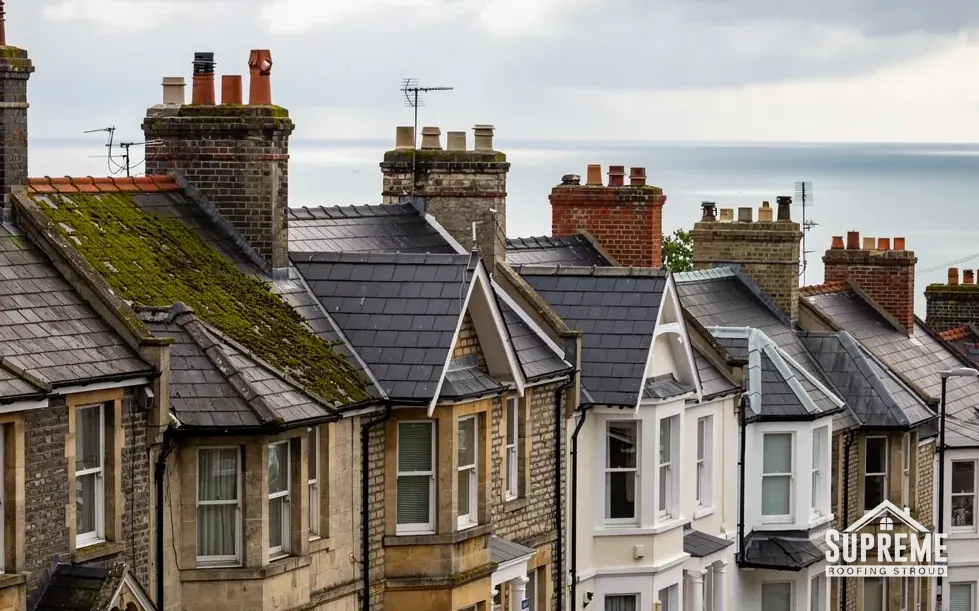
Roofers in Bathampton
Roof work on the south bank of the River Avon, where the Kennet and Avon Canal curves around the village and a quarried slope climbs to Bathampton Down.
Bathampton at a glance
- Distance
- 28.6 road miles south of Stroud
- Council
- Bath and North East Somerset Council
- Conservation area
- Bathampton
- Listed church
- St Nicholas, Grade II*
Bathampton's roofs between the canal and the Down
Bathampton lies on the south bank of the River Avon, and the Kennet and Avon Canal passes around the edge of the village. Behind the houses, a steep slope that was heavily quarried for stone leads up to Bathampton Down. Water on one side and a hillside on the other gives the village a tight, strung-out shape, and that affects almost every roofing job: where a ladder can stand, where scaffold can sit and where materials can be stacked.
The village has layers of its own. The parish church of St Nicholas has 13th-century origins and is Grade II* listed, with a north aisle added in 1858. Plasticine was made in the village from 1900 to 1983 by the company William Harbutt founded, so the working life of the place reached well beyond farming and stone. Buildings from those different periods stand close together, and a survey on one street can mean reading several centuries of repair.
A village with buildings of so many ages has no single roof type, and we never assume one from the lane. We identify each covering from the ladder, photograph it, and price the job from what is actually there. Bathampton has its own conservation area, and Bath and North East Somerset Council is the planning authority.
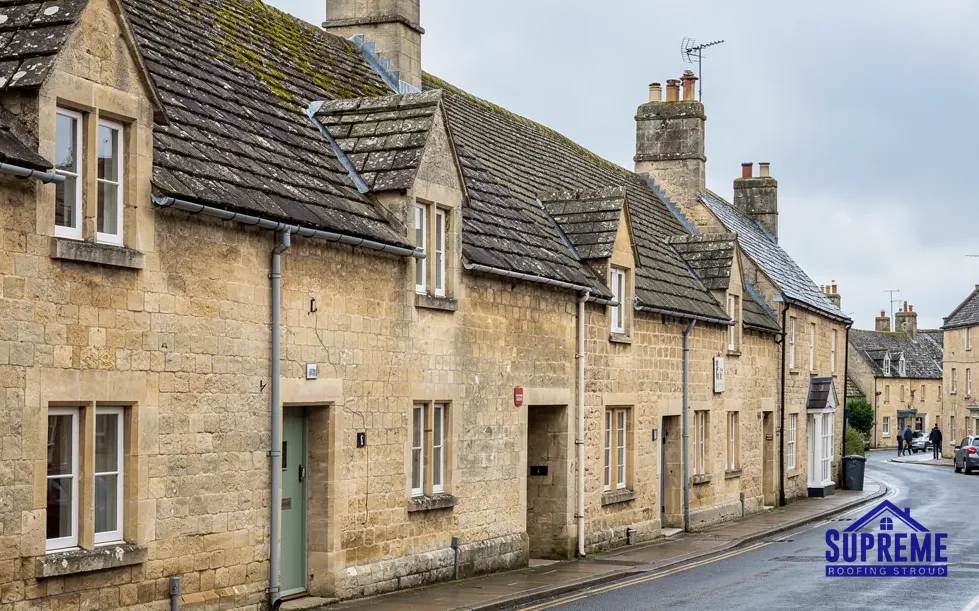
Terrace of stone cottages with dormer windows and stone tile roofs 
Hillside terraces of stone houses with slate roofs and chimneys
Chapter 01
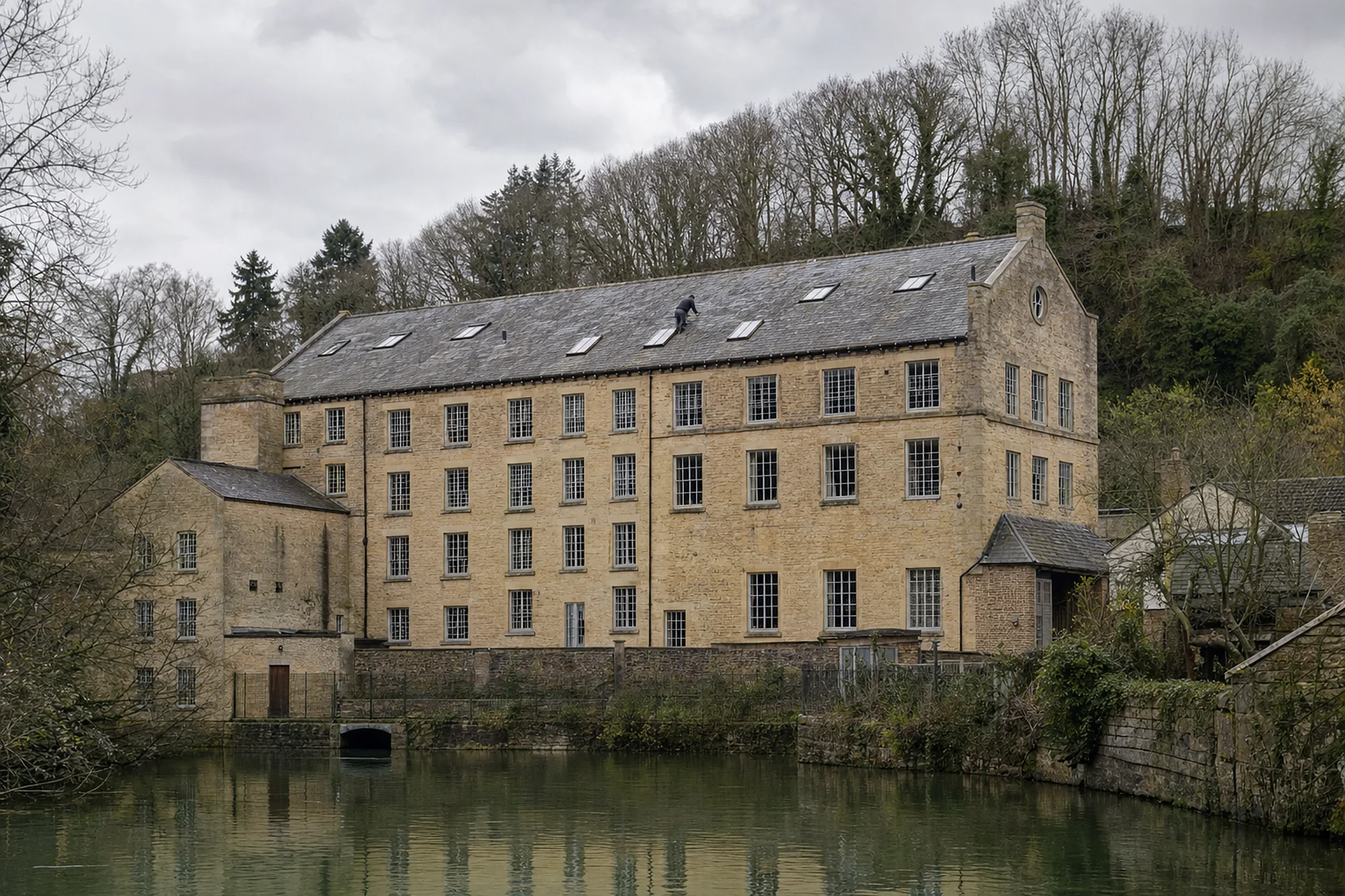
Where the canal and the Avon shape the work
Roofs beside water need their gutters, outlets and shade looked at before anything else.
Chapter 01In this chapter
A village squeezed between a river, a canal and a hillside has little level ground, and the houses sit close together. For the roof, the neighbours matter as much as the weather. A roof shaded by a bank, a wall or a tall tree stays damp for longer than one in open sun, so moss, algae and slow-drying timber are the first things we look for on any building near water. They do not mean the roof is failing. They mean the gutters, the lowest courses and the eaves deserve a proper look, because that is where damp from a shaded slope ends up.
In this chapter
Gutters come first. Leaves and moss wash into the outlets, a choked outlet lets water spill over the gutter lip, and water that spills behind it reaches the fascia, the soffit and eventually the wall plate. On older houses the damage is often in the bottom few courses and the timber behind them, not in the middle of the slope. We photograph the eaves from the ladder so you can see what we see, and the gutter and fascia work goes in the quote, alongside a note of anything that is sound as well as anything that is not, so you can see how the whole roofline is holding up. Our guttering, soffits and fascias page sets out what a typical replacement involves and what it costs nationally.
Moss is a related job. Scraping by hand is gentler on old tiles than a pressure wash, and MyBuilder's 2026 guide puts manual scraping at £5 to £10 per m² and notes that jet-washing risks damage to fragile tiles. If the covering underneath is sound, a clean and a gutter clear-out may be all the roof needs. If the tiles are crumbling, cleaning only shows you the problem, and our roof cleaning and moss removal page explains how we tell the two apart.
Flat-roofed additions deserve the same attention. A kitchen extension or porch with a felt or single-ply roof near a shaded bank can sit with standing water if its falls have settled, and ponding is a common reason for early failure. We check the fall with a straight edge and a level and note where water lies after rain. Our survey photographs go with the quote so you can see the same thing.
Working beside a canal or a river bank
When a property backs onto the canal or the river, the first question is who owns the strip of land beside it and whether scaffold may stand there. We ask at the survey, not on the first morning. Where scaffold cannot sit on the ground behind the house, the options are a frame built from the front, a tower at the gable end, or a roof ladder and crawling boards for a small repair. Each has a cost, and the one that fits goes into the written quote.
On a shaded roof the trouble starts at the eaves.
Chapter 02
The quarried slope under Bathampton Down
Houses on rising ground bring stepped scaffold, carrying and a view of your roof from above.
Chapter 02In this chapter
The ground behind the village climbs steeply, and the hillside itself is the product of quarrying. Houses built against a slope like that are rarely level front to back. A roof that looks low from the street can be a full storey higher at the back, and gardens often drop or rise sharply behind the house. For a roofer, that means the scaffold may need two different heights on one building, with a single low platform at the uphill end and a tall frame at the downhill end.
In this chapter
It also means roofs here are seen from above. Neighbours higher up the hill look down onto your ridge, your valleys and your flashings, so the finish of those details shows in a way it would not on a flat plot. We take care over the lines of ridge tiles and verges for that reason, and we fix ridges mechanically as well as bedding them, since BS 5534:2014 no longer relies on mortar alone. Our roof repairs page covers the smaller fixes that often keep an old roof going.
Where a lane or a steep drive is the only way in, every load is planned. Tiles, battens and rolls of underlay are lifted by hand or on a hoist, the old covering comes down the same way, and the skip may need to sit on the road rather than the property. A skip or a delivery lorry on the highway needs arranging in advance. We put that handling time and the access plan into the written quote, so it is allowed for rather than a surprise.
Changing the covering on a hillside house
Some owners want to swap one covering for another when the roof is stripped. Weight is the first check. The Planning Portal says a new covering that is 15 per cent or more heavier than the old one needs Building Regulations approval, and a structural check goes with it. On a hillside house with older timbers, we raise that at the survey rather than after the quote.
Chapter 03
St Nicholas, the conservation area and the rules around old roofs
A Grade II* church at the centre of the village sets the tone for how nearby roofs are handled.
Chapter 03In this chapter
The Church of St Nicholas has 13th-century origins, a north aisle from 1858 designed by Henry Goodridge, and a Grade II* listing. Its Australia Chapel holds a memorial to Arthur Phillip, first Governor of New South Wales. St Nicholas is in use as a church, which keeps it outside listed building consent: its roof work goes through a faculty granted by the diocese. That is a separate route from the one a homeowner follows, and we mention it because people often assume the same rules apply to every old building in the village.
In this chapter
For a house, the starting question is whether it is listed. If it is, almost any change which alters its character requires listed building consent from the council, and that can include roof details such as the pitch, the covering and the chimney pots. If it is not listed but sits inside the Bathampton conservation area, the rules are lighter but still matter. A like-for-like re-roof rarely counts as development under planning law, so permission is normally not needed. A change of material, a new rooflight or a dormer is different, and dormers are not permitted development in a conservation area. Check with the planning team at Bath and North East Somerset Council before ordering anything.
That is why we work like for like on older roofs. Natural slate goes back as natural slate, clay as clay and stone as stone, with the same courses and the same ridge line. It is the safest way to repair a roof in a protected area, and it keeps the quote straightforward, because we are replacing what is there rather than designing something new.
Older village houses often carry later outbuildings, workshops and extensions, some with lower pitches or flat sections added to older ridges. Where an old roof has been altered in stages, the joins between one phase and the next are where leaks settle, so the survey follows each junction and notes the flashing at it.
Chimneys and the listed skyline
Stacks on older houses are often the most exposed part of the building, and on a listed house the pots and the flaunching, the mortar capping that holds them, can be part of what is protected. Our pitched roofing page explains how a stack, its flashings and the surrounding slopes are dealt with in one visit.
- 1858year the north aisle of St Nicholas was added
- 1900year Harbutt's Plasticine works began production in the village
- 1983year Plasticine production in the village ended
Map showing Bathampton and the Stroud service radius, with nearby towns we also cover.
Near Bathampton
Roof work we do here
Canal curve and quarry slope in Bathampton
My Bathampton house backs onto the slope below the Down. How does that change a re-roof quote?
Mainly through access, and it is rarely a reason to avoid the work. A house against a hillside may need scaffold at two heights, and materials may be carried up steps or a lane by hand. We look at the plot at the survey, photograph the approach and the back of the house, and allow for the scaffold and the handling in the written quote. A tower or a cherry picker is sometimes a cheaper way to reach a small repair, and we say when that is the case.
Does the Bathampton conservation area stop me replacing my roof covering?
No. Putting back the same covering does not generally call for planning permission. A change of material or a new roof feature is different, so check with the planning team at Bath and North East Somerset Council first. If the house is listed, ask about listed building consent too.
Who gives permission for roof work on St Nicholas church itself?
While a church is in worship use, its roof work is authorised by a faculty from the diocese and not by listed building consent. If a church or chapel is no longer in worship use, it normally needs listed building consent from the council.
Can moss be removed safely from a roof near the canal?
Yes. Hand scraping is the gentlest method on old tiles, and we pair it with a gutter clear-out because the moss ends up there. MyBuilder's 2026 guide gives £5 to £10 per m² for manual scraping. We check the tiles first, because crumbling ones need replacing rather than cleaning.