
Roofers in Northleach
Northleach is a market town in the valley of the River Leach, 24.2 road miles out of Stroud, heading east-north-east, built up on wool money and still carrying large roofs from the church to the old prison.
Northleach at a glance
- Distance
- 24.2 road miles east-north-east of Stroud
- Council
- Cotswold District Council
- Conservation area
- Northleach (CONARA/074)
- Setting
- Valley of the River Leach
Northleach roofs, from the wool church to the House of Correction
Northleach is a market town in the valley of the River Leach, in the Cotswolds. Gloucester Abbey founded it as a borough in 1219 or 1220 and granted a charter for a regular market, and in the late Middle Ages it prospered as a centre of the wool trade. That history explains why a town of this size has buildings of real scale. Money from wool paid for the church, and later centuries added an institution on a grand footprint, so Northleach has both very large roofs and the small, tightly packed roofs of an ordinary market town.
The Grade I wool church is dedicated to St Peter and St Paul. The House of Correction was built in 1791 to a design by William Blackburn, a women's wing went on in 1842, and the Old Prison is listed Grade II*. Northleach also has a designated conservation area, which Cotswold District Council records as CONARA/074.
The town stands just east of the Fosse Way on the old Oxford to Gloucester road, which became the A40 and was moved half a mile north onto a bypass in 1984. The roofs here belong to buildings from several centuries, and that a survey has to establish for each one what the covering is, how old it is and whether it has been altered. If your building is listed or stands inside the conservation area, speak to the council's planning team first, since they decide what counts as a change that needs consent. We will photograph the roof and write up the proposed work so that your conversation with them is specific.
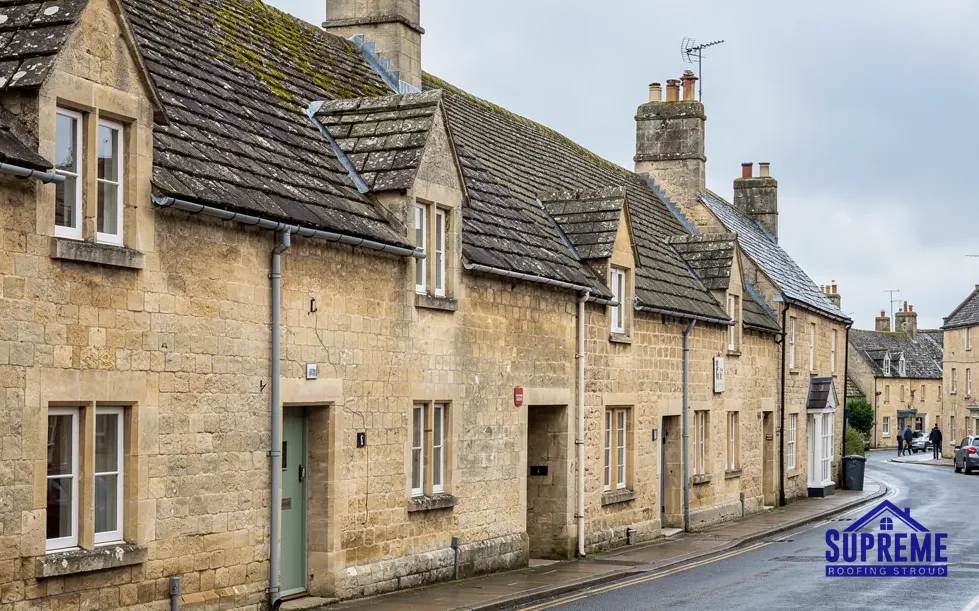
Terrace of stone cottages with dormer windows and stone tile roofs 
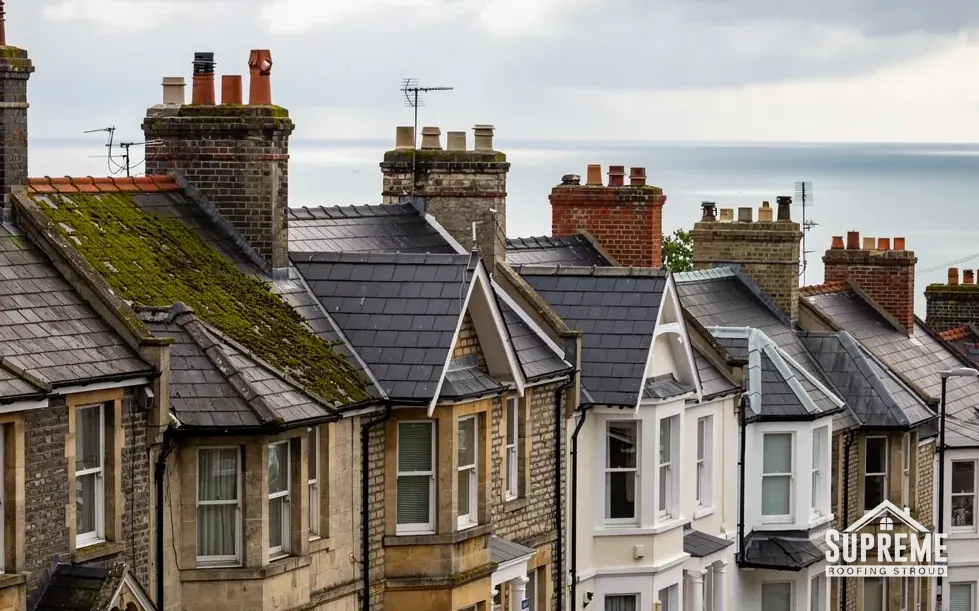
Hillside terraces of stone houses with slate roofs and chimneys
Chapter 01
Wool money and the roofs it left in Northleach
A small borough with big buildings, and what that means for repairs today.
Chapter 01In this chapter
Gloucester Abbey founded Northleach as a borough with a market charter, and the town grew rich as the wool trade peaked in the late Middle Ages. The best-known result is the wool church, a Grade I building. Churches in use are not dealt with through the council: the diocese authorises their roof work by faculty. For an owner of an ordinary house or shop the relevant system is different, and it is worth knowing which one applies before any work starts.
In this chapter
The wool trade matters to a roofer because it explains the age and the variety of what is under the roofs. A market borough that has been trading since the early thirteenth century has had centuries of rebuilding, and roofs here have been raised, extended, patched and stripped many times. Behind a street frontage there can be several different roof structures joined together, with valleys and gutters between them that nobody has looked at since the last repair. Those hidden junctions are where leaks start, and they are the first parts of the roof we ask to see.
We survey with a camera in the roof space as well as outside. Those photographs record the covering from below, the state of the timbers and any chink of daylight, and they travel with the quote so that it has its evidence beside it. A Northleach owner can look at the same pictures we looked at and ask questions before agreeing anything. If an area can be repaired and not replaced, we say which, and what the repair costs, as a separate figure. A typical roof repair costs between £150 and £1,500, according to MyBuilder (2026); the survey tells you where in that range your own roof falls.
Shops and houses sharing a roofline
In a market town the roofs of neighbouring buildings often touch. A gutter may serve two properties, a valley may run between two owners, and a chimney stack may sit on the wall that divides them. Before work begins we ask who owns which part of a shared junction, and we put the answer in the quote so that nobody is surprised when the scaffold goes up. Where a job covers a shop and the flat above it, our commercial roofing page explains how larger and mixed-use roofs are handled.
The oldest part of a roof is often the most reliable and the newest repair the weakest.
Chapter 02
The House of Correction, Blackburn's design and two building phases
A 1791 institution with an 1842 wing shows what happens where two periods of roof meet.
Chapter 02In this chapter
The House of Correction at Northleach was built in 1791 to a design by William Blackburn. A women's wing was added in 1842, fifty-one years later, and the Old Prison is now listed Grade II*. Those two dates are a handy illustration for anyone with a building of more than one phase, because a join between old and new is where roofs most often give trouble.
In this chapter
When a wing is added to an existing building, the new roof has to meet the old one. The two may have been built to different pitches, with different timber sizes and different coverings. The junction usually has a valley gutter or a flashing, and that detail has to cope with the roofs moving at different rates as the seasons change. After a few decades the lead can crack, the mortar fillets can fall away and the timbers behind them can rot. A quick look from the ground will not reveal it. We examine each junction close up, and where lead is needed we choose the code to suit the job; Leadworx puts Code 4 forward for everyday flashings, with heavier sheet reserved for valleys and wider areas where the lead has more to carry.
Large institutional roofs also bring their own drainage. Long gutters, parapet gutters behind stone upstands and downpipes run through the walls are common on a building of that period, and one blocked outlet can put a great deal of water in the wrong place. Our surveys include a drainage section, with photographs of every outlet and a note of where each downpipe discharges, and the outlets, the gutter runs and the valleys each get a price of their own.
Roofs on a large footprint
Big roofs are as much about logistics as about materials, and a building the size of the House of Correction would show that on any survey. A scaffold across several wings is a substantial structure, and it has to be planned around entrances, neighbours and the position of the waste skip. Large jobs are broken into stages so that a building can stay in use while a single area is made watertight. Where a listed building is involved, we describe every change in writing for the planning team before work is booked, and we keep the materials as they were. Our lead roofing page sets out the thicknesses and codes we use at valleys, flashings and parapets.
- 1791year the House of Correction was built to William Blackburn's design
- 1842year a women's wing was added
- 1219year, or the year after, that Gloucester Abbey founded the borough

Chapter 03
Working inside Northleach's conservation area boundary
Which roof jobs need a notice, which need consent and which need nothing at all.
Chapter 03In this chapter
One thing every Northleach owner can do before ringing a roofer is find out what the building is. Northleach has a designated conservation area, recorded by Cotswold District Council as CONARA/074. The council's planning team is where to start for anything that changes how a roof looks, and the answer depends on the building. This table sets out the main routes in the order a homeowner usually meets them.
In this chapter
Which rules apply to which roof
The point of the table is that most roof repairs in the town need nothing from the council at all, and the cases that do are easy to recognise. A like-for-like repair to an unlisted house is outside planning control in most cases, but we still ask the planning team to confirm when a property sits in the conservation area and the work is anything more than minor patching. Where a covering is changed for something heavier, the structure needs checking, and Building Regulations may apply.
Work on a listed house is different. The whole building has protection inside and out, so even a modest repair may need consent if it affects the character of the roof. The Old Prison is listed Grade II*, so any change to its roofs would be judged against that protection, and the same logic applies on a smaller scale to a listed cottage or shop in the town. If you own a listed property here, we suggest you describe the roof job to the council in writing before the survey, and we will provide photographs and a specification to go with it.
If notification is needed for Building Regulations, we explain it and handle it. According to the Planning Portal, a re-roof touching less than 25 per cent of the building envelope and less than 50 per cent of the roof does not normally need a building control application. If we find that your roof is likely to cross either line, we flag it at the survey and quote both versions of the work. Past those figures approval is required, and thermal insulation can come into the scope of the work, so the extent of the job is worth settling before the quote. Our roof inspections and surveys page describes what we photograph so that the decision rests on evidence rather than a guess.
| Roof job | Where to start |
|---|---|
| Small repair, same material, unlisted house | Normally no application; ask the planning team if in doubt |
| Change of covering in the conservation area | Ask Cotswold District Council's planning team first |
| Work on a listed house | Listed building consent, from the council |
| Roof work on a church in use | Faculty, from the diocese |
| Re-roof above the Planning Portal limits | Building Regulations approval |
Map showing Northleach and the Stroud service radius, with nearby towns we also cover.
Near Northleach
Roof work we do here
The wool church and the House of Correction
Why do the older Northleach buildings seem to have several roofs joined together?
Buildings that have been used for centuries are usually extended, raised and altered, and each change adds a roof that has to meet the last one. The meeting points need valleys, flashings or gutters, and these are the places we inspect first.
If the Old Prison is listed, are the houses around it listed as well?
No. A listing covers the building it names, and a neighbouring house is protected only if it has a listing of its own, though both may sit in the conservation area. The conservation area, CONARA/074, is a separate layer of control and applies across its boundary. Cotswold District Council can confirm what applies to your address.
Can a Northleach shop with a flat above be re-roofed in stages?
Yes. Staging suits mixed-use buildings, and the survey sets out the order of work and the scaffold. The shop can keep trading, and the flat is made watertight section by section.
Is a Northleach roof repair covered by a guarantee?
Our work carries a 10-year workmanship guarantee in writing. It covers how the job was done and not the age of the original materials, which is why the survey records the condition of what stays as well as what is replaced.