

Roofers in Chedworth
Chedworth stretches for about two kilometres along a valley at the head of a Coln tributary, 22.2 road miles from Stroud towards the east-north-east, and its stone cottages, farmhouses and later bungalows are roofed in very different ways.
Chedworth at a glance
- Distance
- 22.2 road miles east-north-east of Stroud
- Council
- Cotswold District Council
- Conservation area
- Chedworth, designated 1977
- Setting
- Long valley village at the head of a Coln tributary
Chedworth's roofs along the valley and up to the spring
Chedworth lies at the head of a broad valley formed by a tributary of the River Coln. The church and the manor house stand on the hillside beside a copious spring, and from that point the village spread down the valley through the late seventeenth and eighteenth centuries until it ran for about two kilometres. A village that long has no single centre, so a roofer working here moves between hillside lanes, valley-floor cottages and the roads that link them.
The Victoria County History describes most of the houses along the valley as stone-built cottages and small farmhouses of the eighteenth and early nineteenth centuries, and says none in the older core appears to be earlier than the late seventeenth century. That tells you the age of a typical Chedworth roof structure: timbers a couple of centuries old, carrying a covering that has very probably been renewed at least once. Later arrivals include mid-twentieth-century infill, bungalows on Fields Road and council houses, built in among the older stone.
Chedworth Roman Villa, found in 1864 and taken over by the National Trust in 1924, is one of the most extensive uncovered in England. The Church of St Andrew is Grade I listed, and the village has a conservation area, designated on 19 April 1977 according to the national dataset. If your cottage is listed or lies within that area, talk to Cotswold District Council's planning team before settling on a roof plan.

Hillside terraces of stone houses with slate roofs and chimneys 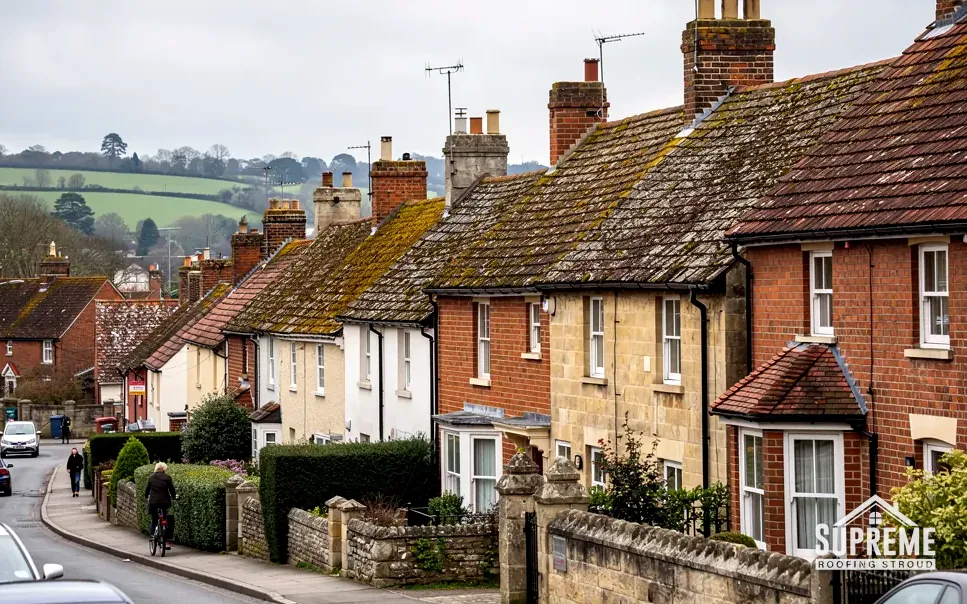
Sloping street of brick and stone terraced houses with mossy tiled roofs

Chapter 01
A two-kilometre ribbon of cottages and small farmhouses
Houses of the 1700s and early 1800s, spread out along one long valley.
Chapter 01In this chapter
A village that grew by spreading along a valley, not around a green or a market, ends up as a ribbon of houses. In Chedworth the ribbon is about two kilometres long, and the eighteenth-century cottages and small farmhouses in it were built one by one over a century or more. They share a type, but they do not share a builder, and no two roofs are quite alike in their pitch, their eaves height or the way the chimneys sit.
In this chapter
That variety is the first thing a survey has to deal with. Before we can price a repair we need to know what the covering is, how it is fixed, and what has been done to it in the past. Old cottage roofs collect repairs: a patch of cement fillet round a chimney, a few replacement tiles in a different colour, a run of ridge that has been rebedded more than once. Each patch tells us something about where water has been getting in. We photograph all of it, from the ladder or scaffold and from inside the roof space, and the pictures go with the written quote.
The small farmhouses are usually the larger roofs, with long ranges, gables at either end and sometimes a lean-to or outhouse added on at the back. Valleys and abutments, where one roof meets another or a roof meets a wall, are the likeliest places for a leak on a building like that. Lead flashing in those spots lasts a very long time when it is correctly fitted. MyJobQuote gives a flashing life of over 80 years for lead put in well, and the codes we use are set out on our lead roofing page.
Getting along the ribbon
Because the houses are spread out, every job has its own access question. One cottage sits on a lane wide enough for a lorry, the next at the end of a track that is not. We work out the carry, the scaffold position and the waste route for the particular property, and the quote allows for each. A cottage on a long run from the road may need materials moved by hand, and the labour for that is allowed for in the quote.
On a ribbon village every roof has its own route in.
Myth: A cottage roof that is two centuries old must be replaced.
Fact: Old roofs are often repaired, patch by patch, and the survey photographs show which parts have failed and which have not.

Chapter 02
The spring, the church and the hillside above the valley
Where Chedworth began, and why water is part of every roof conversation there.
Chapter 02In this chapter
The oldest part of Chedworth is on the hillside, where the church and the manor house stand beside a copious spring. The Church of St Andrew is Grade I listed. The Victoria County History places the village at the head of the valley, which means that water in that part of Chedworth has always had somewhere to go, and the buildings were laid out around it.
For a roofer, a village with a spring in it brings a particular habit of mind. We want to know where the water from the roof goes, because a roof can be perfectly sound and still leave a wall wet if the gutter outlets, the downpipes and the ground at the base of the wall are not doing their job. On an old stone cottage, damp that shows inside the house is often blamed on the roof first. The survey separates the two, so that you are not paying for a new covering to fix a drainage problem. Our guttering, soffits and fascias page explains the falls and fixings we use when gutters do need replacing.
On a hillside the roof work has a second dimension, which is height. Houses on the upper slope may have front doors on one level and eaves at three storeys on the other, so scaffold is built stepped and the quote reflects it. Where a roof can be reached safely by ladder and the job is small, we will tell you; there is no point in building scaffold for a few slipped tiles if the repair can be done without.

Churchyard neighbours and listed rules
Houses next to a listed church or a manor house are likely to be in the conservation area, and some may be listed in their own right. A listed house needs listed building consent for work that changes its character, while the church itself, being in use, is covered by a faculty from the diocese instead. If you are not sure which rules apply to your cottage, tell us the address. We will describe the work in plain terms that you can put to the planning team at Cotswold District Council.

Old timbers on the Chedworth hillside
Roofs on cottages of this age have timbers that were cut for the job and have since dried, flexed and sometimes been attacked by beetle. In the roof space we look for daylight, stained timber and anywhere the wall plate has moved. None of that is cause for alarm. Each finding goes into the survey notes, and we sort the items into repairs that should be done now and repairs that can wait a season, so that you decide the order and the budget with the facts in front of you.
- 1864year Chedworth Roman Villa was found
- 1924year the National Trust took the villa over
- 2 kmlength of the valley the village spread along by the 18th century
Chapter 03
Fields Road bungalows and the council houses among the cottages
Twentieth-century building filled the gaps between Chedworth's old farmhouses.
Chapter 03In this chapter
The County History notes mid-twentieth-century infill in Chedworth, with bungalows on Fields Road and council houses set among the older cottages. That is enough to tell us what to expect: a layer of building from a later period sitting between and behind the stone cottages, and roofs that were designed on a different system from the older ones.
A mid-century bungalow is a straightforward roof to describe and a surprisingly varied one to repair. The pitch is low to medium, the covering may be a concrete tile or similar, and the structure is made of softwood trusses rather than the hand-cut timbers of an eighteenth-century cottage. The weak points are different too. Fixings on the tile battens, the felt beneath the covering, the mortar at the ridge and verge and the flashing where an extension joins the main roof are the areas we look at first. Under BS 5534:2014 a bedded ridge or hip is also fixed mechanically, because the mortar is not trusted to hold the tiles on its own; our ridge, verge and dry-fix page explains what that looks like.
Council houses of the same period can come in pairs or short terraces, and where they do, a defect on one roof may well be found on the one next door. If a neighbour is planning work, tell us; two roofs surveyed together can share a scaffold and a skip, and the cost of those is then divided.
Choosing a covering for a later house
Replacing a covering on a later house is a different decision from replacing one on a cottage. Like for like still matters, but the options are wider, and the weight of the new covering has to be checked against the structure. A covering that is 15% or more heavier needs Building Regulations approval, so we tell you the weight of what we propose.
Flat roofs on extensions
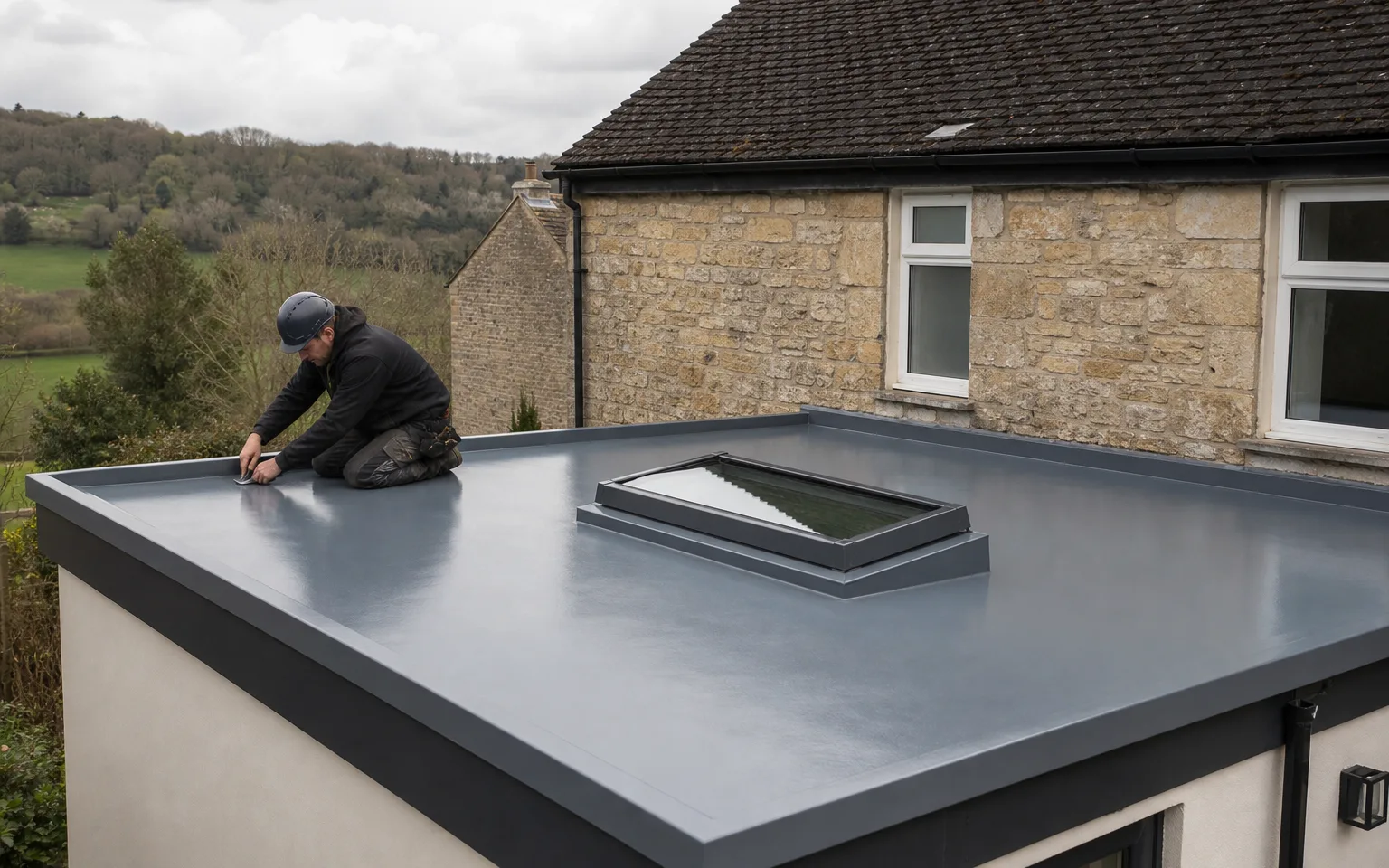
Extensions and garages built onto bungalows often have flat roofs, and those age faster than the pitched roof beside them. Flat roofs generally last between 15 and 30 years, according to MyBuilder (2026). We survey the outlets, the upstands and the falls, and if the whole roof needs recovering, the quote covers the removal, the deck repairs and the new membrane.
Map showing Chedworth and the Stroud service radius, with nearby towns we also cover.
Near Chedworth
Roof work we do here
Fields Road bungalows and valley cottages in Chedworth
Do the stone-built cottages along Chedworth's valley need special roofing materials?
The covering on each cottage is whatever it is, and the survey identifies it. Where the existing roof is stone, we keep stone, and where it is tile or slate we match the original. We do not swap one material for another to save money, because the cottage would look wrong and a listed or conservation-area house may need consent for the change.
My Chedworth cottage has damp walls. Is the roof to blame?
Sometimes, but not always. A blocked gutter or a downpipe that discharges against the wall can soak stonework without a single slate being out of place. The survey checks the covering and the drainage separately so you only pay for the fix that is needed.
Does the Chedworth conservation area affect a bungalow on Fields Road?
It might, depending on where the property sits. The conservation area was designated in 1977, and Cotswold District Council's planning team can tell you whether your address falls inside the boundary. A repair that puts back what was there is a simpler conversation with the council than a change of material.
How is a long carry from the lane handled in a Chedworth quote?
The labour for carrying materials, and the scaffold needed for the position of the house, are allowed for in the written quote. We also give you a 10-year workmanship guarantee in writing, which covers our work whatever the access was like.