
Roofers in Corse
Roof work in Corse means a moated Grade II* manor house, a medieval church and a Chartist cottage estate, all on low ground between the Severn and the Leadon.
Corse at a glance
- Distance
- 17.4 road miles north-north-west of Stroud
- Council
- Forest of Dean District Council
- Conservation area
- Staunton and Corse, including Snigs End
- Setting
- Low ground between the Severn and the Leadon
Corse Court, Snig's End and the ground between two rivers
Corse parish lies between the River Severn and the River Leadon, next to Staunton and about 6 miles north of Gloucester. It is a small place, home to 592 people at the 2021 count, and its roofs fall into groups that hardly overlap. There is the medieval core around the church, there is the Chartist cottage estate, and there are the houses that arrived in between.
Most of St Margaret's Church dates from the late 14th century, with a font from the 12th. It stands beside Corse Court, a moated former manor house that is listed Grade II* and has 14th-century origins with later extensions. A building that has grown in stages has roofs that meet at valleys, abutments and changes of pitch, and those junctions are where water finds its way in.
The other landmark is Snig's End. The National Land Company bought the estate in 1847 as the third of the Chartist estates, and by 1848 a school-house and 85 cottages had been built on it. Part of it sits inside the Staunton and Corse Conservation Area, which Forest of Dean District Council administers. Before you compare any quotes here, find out which of these groups your own house belongs to, because the rules and the roofs differ between them.

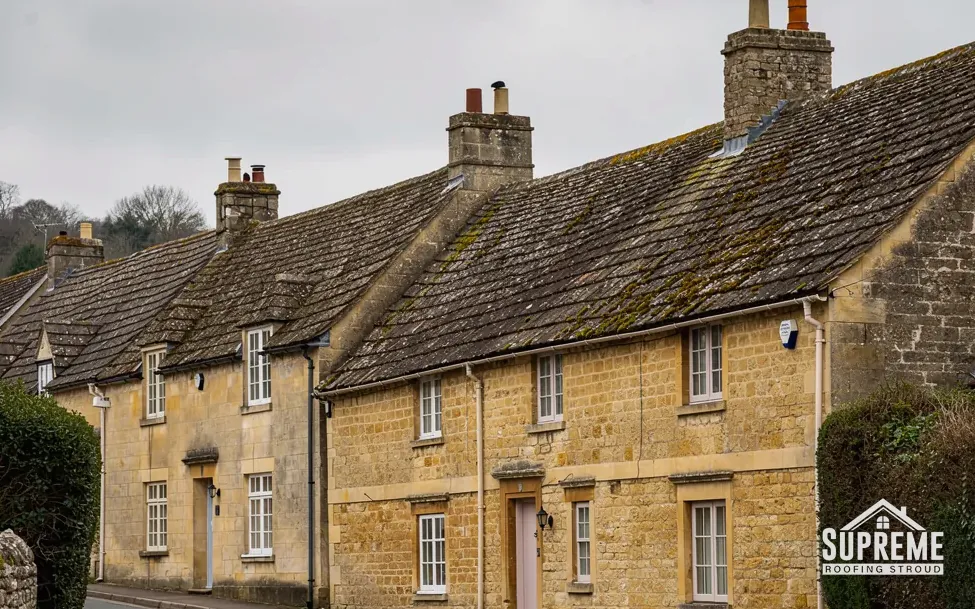
Row of stone cottages with mossy clay tile roofs along a quiet lane 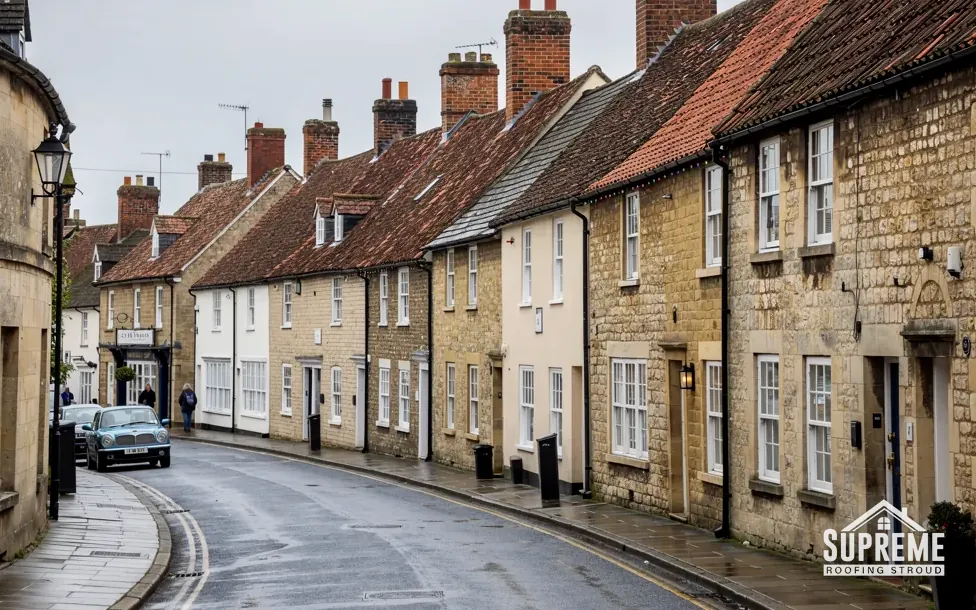
Curving street of stone and rendered terraced houses with tiled roofs
Chapter 01
Corse Court, St Margaret's and the old parish core
A listed manor house and a medieval church need a slower, paperwork-first approach.
Chapter 01In this chapter
Corse Court, with its 14th-century origins, carries one of the oldest roofs in the parish. Its Grade II* listing puts every part of the house under legal protection, roof and interior alike. The council, not the owner, decides whether a roof change is acceptable, and the route is listed building consent from Forest of Dean District Council. That can cover swapping a covering, altering a verge or rebuilding a stack. Repairs that simply put back what was there are easier to agree, but we would still check with the council's conservation officer before starting, because a phone call costs far less than a stopped job.
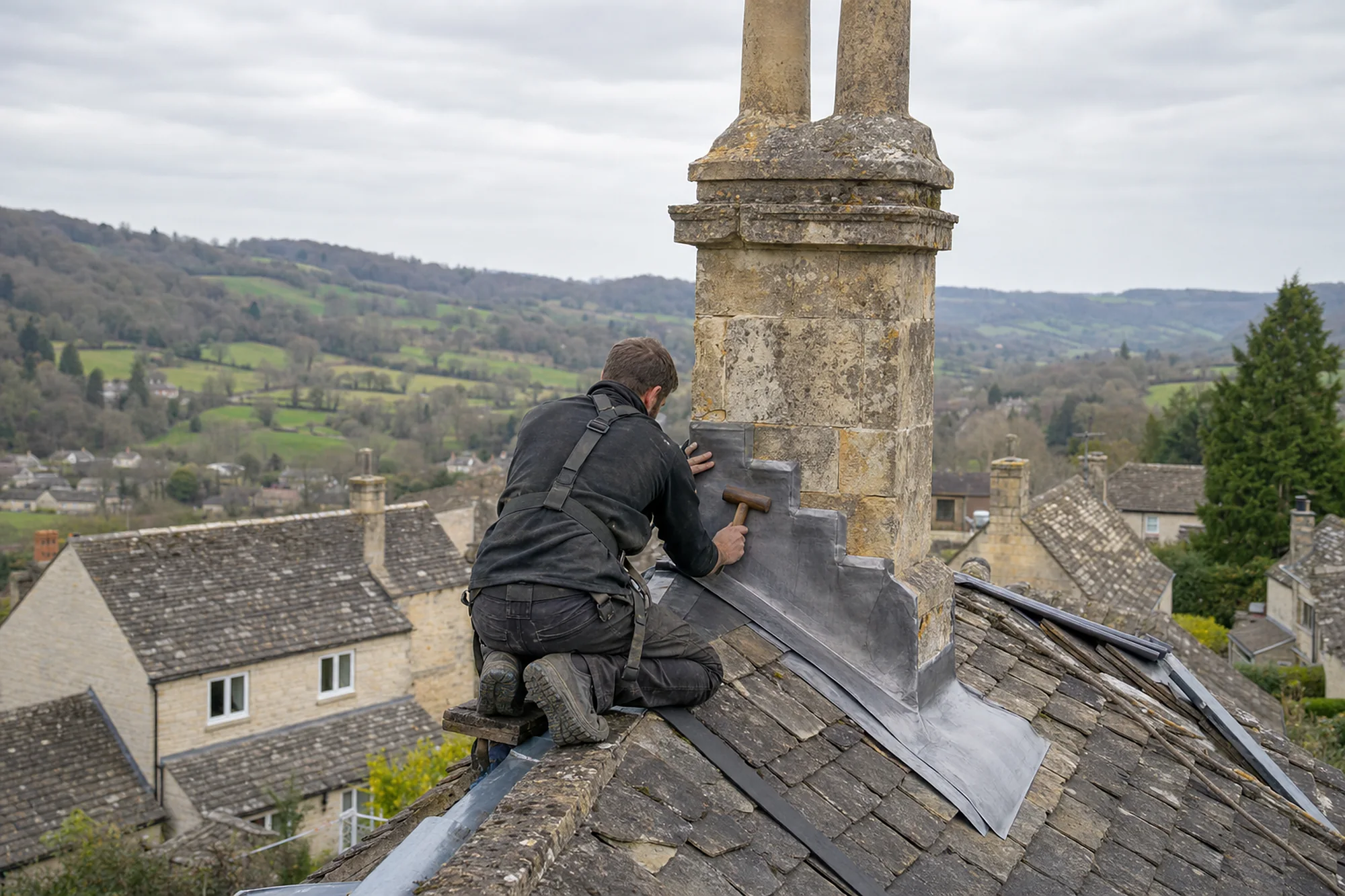
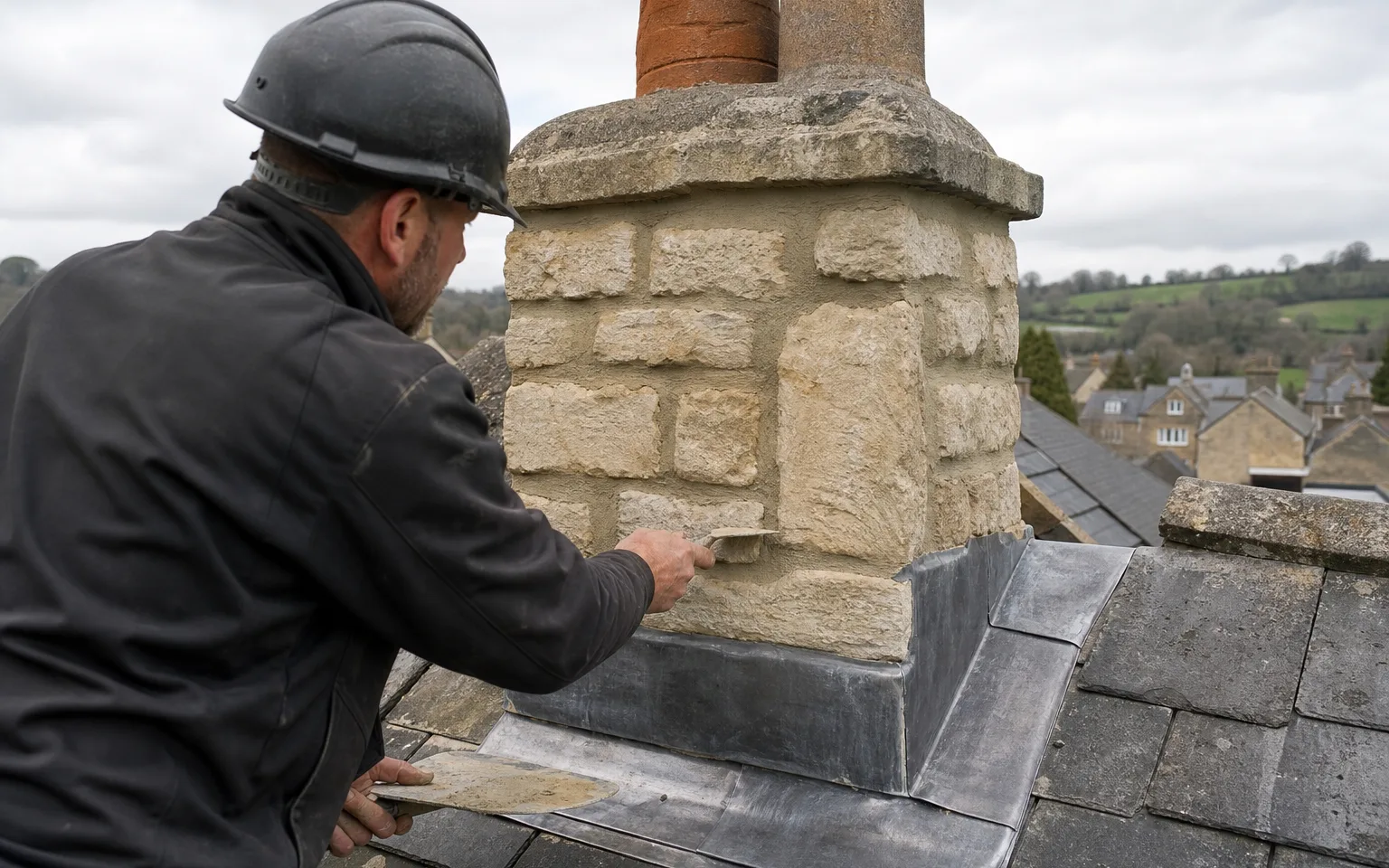
A house with 14th-century origins and later extensions has the roof history of every century it has lived through. Different ranges were added at different times, so you tend to find several pitches, several coverings of different ages, and lead or mortar flashing at every point where one range meets another. When we survey a building like that, we photograph each junction and write them up one by one. The quote then covers valleys, abutments and stacks, so it reflects the whole roof rather than a guess.
The moat is a practical consideration as well as a historic one. Water beside a building changes where a scaffold can stand and where materials can be stacked, so the access plan is settled at the survey. It goes in writing with the quote, and it is never left to be worked out on the first morning.
St Margaret's and the faculty route
St Margaret's is still a working church, so the ecclesiastical exemption applies. Roof work there is authorised through a faculty from the diocese and not through the council's listed building consent. The parish normally leads that process with the diocese's advisers. Where a contractor is asked to price a repair, the useful thing we can do is give a clear written description of the problem, with photographs of the roof, so that whoever is deciding has something concrete to look at.
Corse Chase in the background
The parish has older layers than its buildings. Corse Chase, held by the Earls of Gloucester in the 12th century, covered much of the land between the Severn and the Leadon, and deer were still recorded there in 1628. It is a reminder that the settlement pattern here is old and thin, with long gaps between buildings, which matters when a delivery lorry has to reach a roof along a narrow approach.
On a building that has grown in stages, the roof story is told at the junctions.
- Grade II*listing for Corse Court, a moated former manor house
- 12th centurydate of the font in St Margaret's Church
- 1628year deer were still recorded on Corse Chase

Chapter 02
Snig's End: 85 cottages and a Heritage at Risk listing
One estate, one plan, and a conservation area that now carries a national warning.
Chapter 02In this chapter
The Chartist land estates were an attempt to settle working families on small holdings of their own. Snig's End was the third of them, bought by the National Land Company in 1847. The company had built a school-house and 85 cottages by 1848, and that speed is visible in the way the cottages repeat one another. They were laid out as a deliberate plan, each on its own plot, and the character of the place comes from that repetition.
In this chapter
In November 2025 the Snigs End Conservation Area was added to Historic England's Heritage at Risk register, after Forest of Dean District Council nominated it, and the entry describes it as in poor condition and deteriorating. The reasons given were individual alterations to the original cottages and the sub-division of the original plots. That is a useful thing to know before you commission any roof work here. It tells you the council and Historic England are watching the cumulative effect of small changes, and roof coverings, rooflights, dormers and replacement chimney stacks are among the most visible of those changes.
For a cottage owner, the practical approach is straightforward. The safest route is a repair that matches what is there, using the same material in the same pattern with the ridge and verge lines unchanged, which also keeps the roof matching its neighbours. A change of covering, a new opening in the roof or an altered chimney is different. For that, ask Forest of Dean District Council's planning team what applies to your particular house before you instruct anybody. Where a proposal needs the council's answer before work starts, we flag it at the survey, not halfway through the job.
Repairing without altering
When a roof on one of these cottages starts leaking, there is a temptation to treat it as an excuse to upgrade the whole thing. We would rather identify exactly where the water is getting in, repair that, and photograph the rest so you have a record of its condition. If a full re-roof is later justified, those photographs from the survey make the case for it far more clearly than a general impression would. Our roof inspections and surveys page explains what a survey records and what the written report contains.
Myth: A small roof change on one cottage is nobody's business but the owner's.
Fact: Snigs End was placed on the Heritage at Risk register because of individual alterations to the original cottages, so each change counts towards the whole.
Matching the row
The cottages work as a group, so a repair that is visibly different from its neighbours stands out from the lane. We note the neighbouring roofs at the survey and propose a covering that sits alongside them. If a particular tile or slate has gone out of production, we match the nearest colour, size and texture and do not simply order whatever arrives soonest.
Chapter 03
Low ground between the Severn and the Leadon: water, gutters and access
Where the land is low, how a roof sheds its water matters as much as the covering.
Chapter 03In this chapter
Corse sits on low ground between two rivers, and a roof in a setting like that has to get rid of its water quickly and cleanly. Rainfall and river levels are beyond any roofer's reach. What we can do is look at the one part of the system we control, which is how water leaves the roof and where it goes next.
In this chapter
That starts at the gutters. On older houses and farm buildings, cast or pressed metal gutters have often been patched with plastic runs over the years, and the joints between the two are a frequent source of drips behind the fascia. Downpipes that discharge close to a wall can soak the base of the masonry, and a cracked or blocked gully sends that water straight back at the foundations. During a survey we trace each downpipe to the ground and note where it ends. Where the roof is sound but the water handling is poor, we report that, because a new covering will not cure a problem that begins at the gutter. The guttering, soffits and fascias page sets out typical costs and the signs of failure to watch for.
Getting a scaffold in
A scattered village means scattered access. Properties along narrow roads, behind gates or beside a moat or watercourse need a scaffold plan that suits each one. We look at where the lorry can stand, how far materials must be carried, and whether the scaffold can be built on solid ground or needs boards to spread the load. Those details go into the written quote, so you can see the cost of reaching the roof before any work starts.
Repairs in the meantime
If a roof is leaking before the right repair can be arranged, we prioritise leaks and make the roof safe first. A temporary cover and a note of exactly what was done will protect the interior while the proper repair is planned and, where relevant, agreed with the council. Our roof repairs page explains how we separate an emergency make-safe from the permanent fix.
When we finish, nothing of ours is left behind: scaffold, offcuts and waste all leave with us. The workmanship is covered by a 10-year written guarantee, which applies to our work and not to the materials or to anything that was already failing.
Map showing Corse and the Stroud service radius, with nearby towns we also cover.
Near Corse
Roof work we do here
Snig's End cottages and moated Corse Court
Can I replace the roof covering on a Snig's End cottage?
It depends on the house, so ask Forest of Dean District Council's planning team first. The estate sits in the Staunton and Corse Conservation Area, which is on the Heritage at Risk register. A matching repair is the straightforward route. A different material needs the council's answer before we price it.
Whose approval does a repair to St Margaret's roof need?
St Margaret's still holds services as part of the West of Severn benefice, which keeps it inside the ecclesiastical exemption: the Diocese of Gloucester grants a faculty, and the district council has no consent role. The parish leads the application. We can supply a written description of the fault and photographs of the roof to support it.
What does Corse Court's Grade II* listing mean for roof repairs?
Listing covers the whole building, front and back, interior and exterior, and changes to its character go to Forest of Dean District Council for listed building consent. We survey each junction between its different ranges, photograph them, and include valleys and abutments in the quote.
How do you deal with a moat or watercourse next to a roof?
We settle it at the survey. Water beside a building changes where scaffold can stand and where materials are stacked, so the access plan goes in writing with the quote. Nothing is left to be worked out on the first morning of the job.