
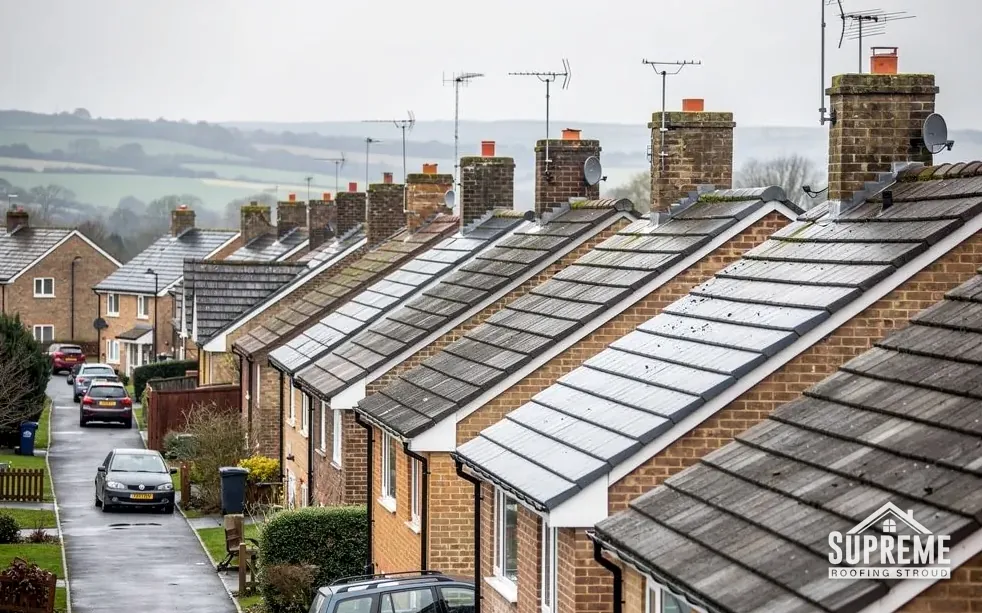
Roofers in Chipping Campden
Cotswold stone roofs along a wool town's terraced High Street, where a Grade I market hall and a Grade I wool church set the standard that every repair is judged against.
Chipping Campden at a glance
- Distance
- 39.5 road miles north-east of Stroud
- Council
- Cotswold District Council
- Conservation area
- Chipping Campden Conservation Area
- Setting
- North Cotswold wool town
The High Street's limestone, from the wool merchants to the Guild
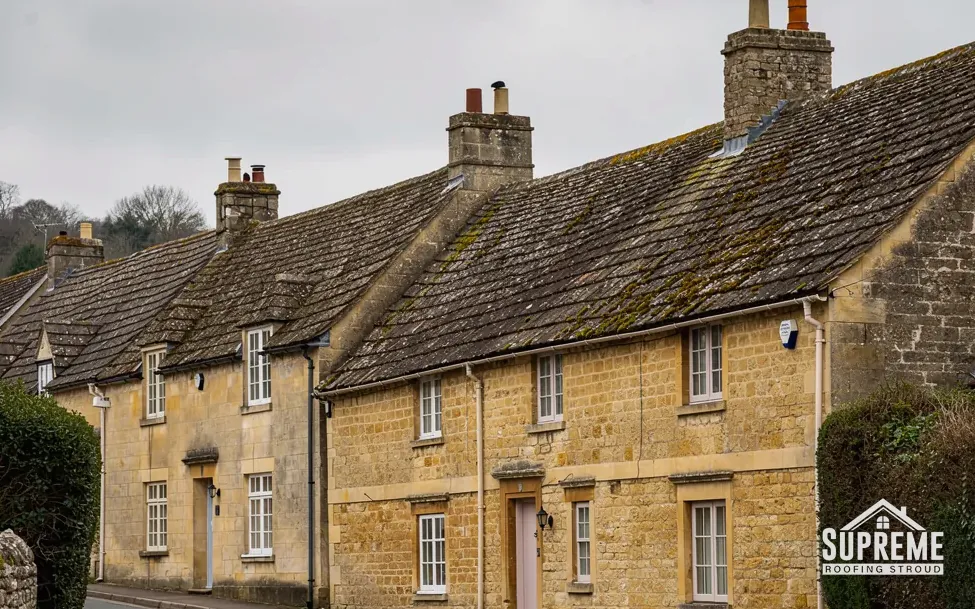
Chipping Campden grew rich on wool. In the Middle Ages it was a trading centre, patronised by wealthy merchants such as William Greville, who died in 1401, and the money they made can still be read in the buildings. The terraced High Street dates from the 14th to the 17th centuries and is built of locally quarried oolitic limestone, the Cotswold stone that gives the town its colour.
Three buildings set the top of the scale. The Market Hall, put up in 1627 by Sir Baptist Hicks, is Grade I listed. So are Grevel's House, built around 1380, and St James' Church, a Perpendicular 'wool church'. Chipping Campden also has its own conservation area, so the ordinary houses around these landmarks are looked at with the same care as the landmarks themselves.
The town has a second chapter too. In 1902 Charles Robert Ashbee moved his Guild of Handicraft here from London's East End and used the Old Silk Mill as its headquarters. A former craft workshop and a merchant's terrace ask different things of a roofer, and we price them as different jobs. What they share is stone: stone walls that carry the load, and, on the older roofs, stone slates that can be repaired many times over if the work is done in the right order.

Stone village houses with slate and tile roofs above green fields 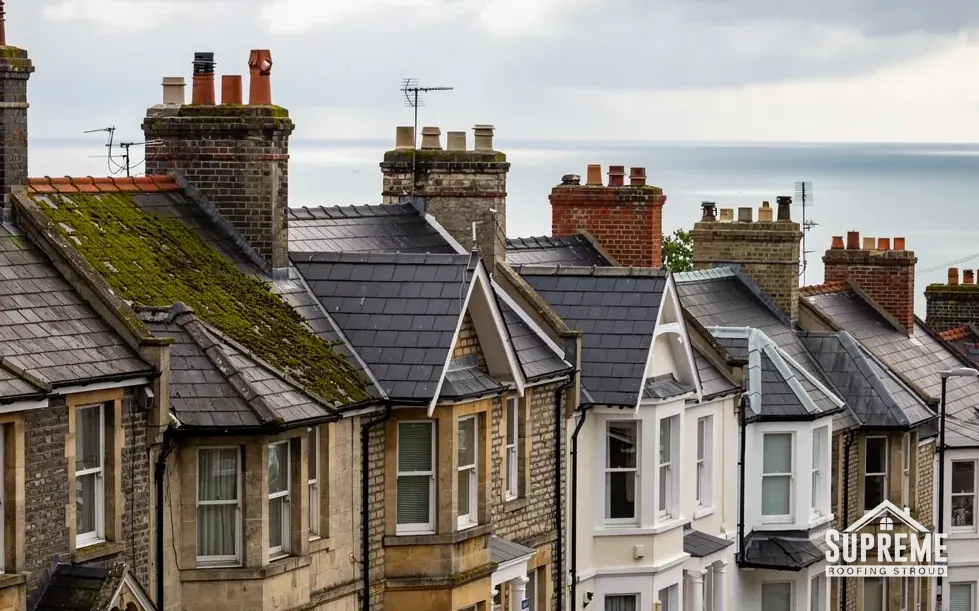
Row of Victorian terraced houses with slate roofs, bay windows and brick chimneys
Chapter 01
Reading the stone slates on a merchant's terrace
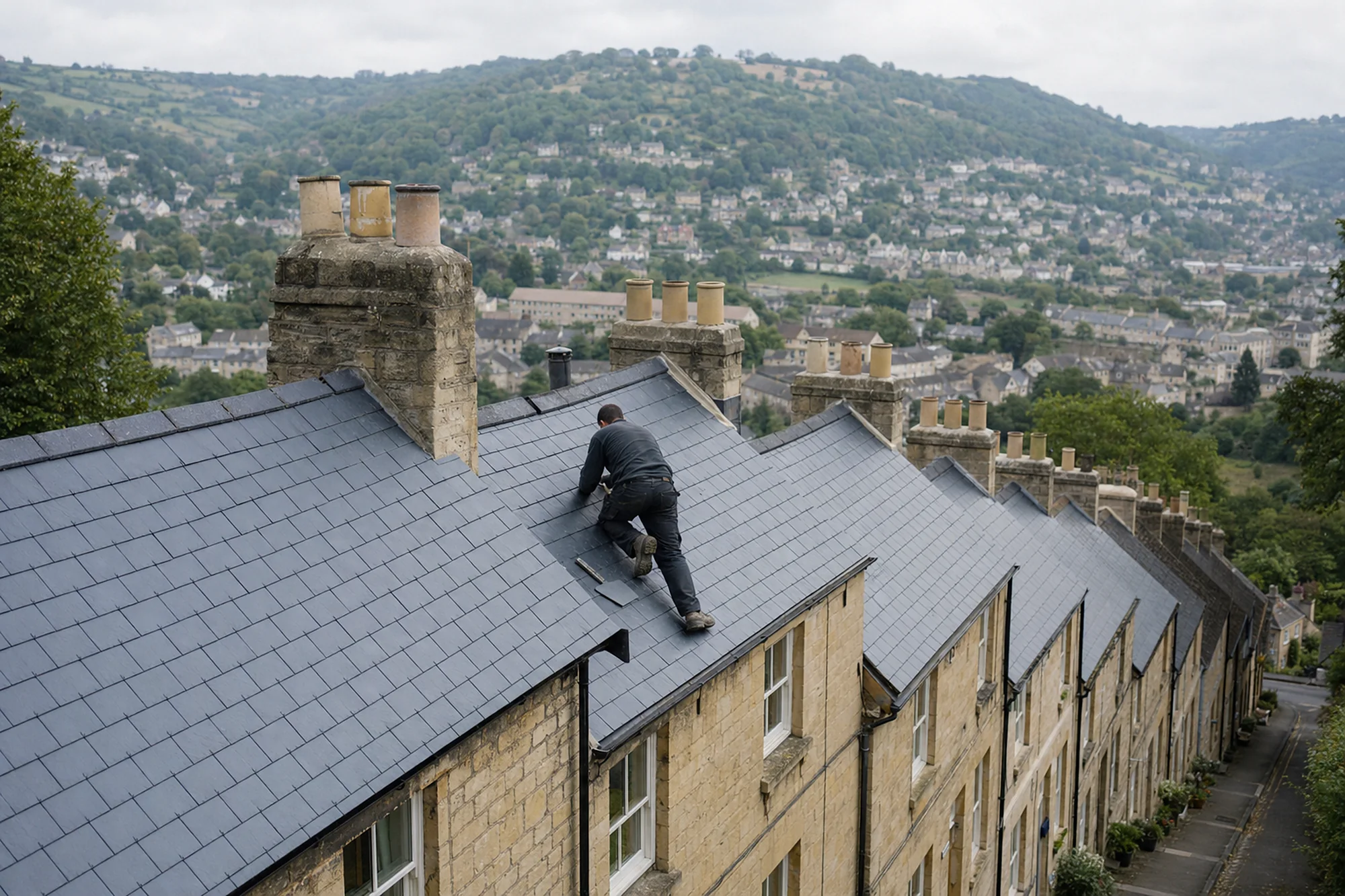
A Campden roof is a ledger in stone: large pieces low down, small ones high up, and each repair has to keep the sums right.
Chapter 01In this chapter
Stone slate is the covering most people picture when they think of a north Cotswold roof, and the council's own technical guidance from April 2000 describes the north end of its range as running from this town. In that guidance the northern districts say 'stone slate' and the south says 'stone tile'. Either way the covering is oolitic limestone, split from one of two beds, Forest Marble by hand or Stonesfield Slate by frost.
The first thing to understand is the gradation. Quarried stone yields small pieces in far greater numbers than big ones, so roofers laid the heaviest slates in a double course at the eaves and shrank the pieces gradually up the slope, finishing with the smallest at the top. That pattern, called diminishing courses, is what makes the roof shed water and what makes it look right from the pavement. If a repair swaps in slates of the wrong size, the courses stop lining up and a leak usually follows.
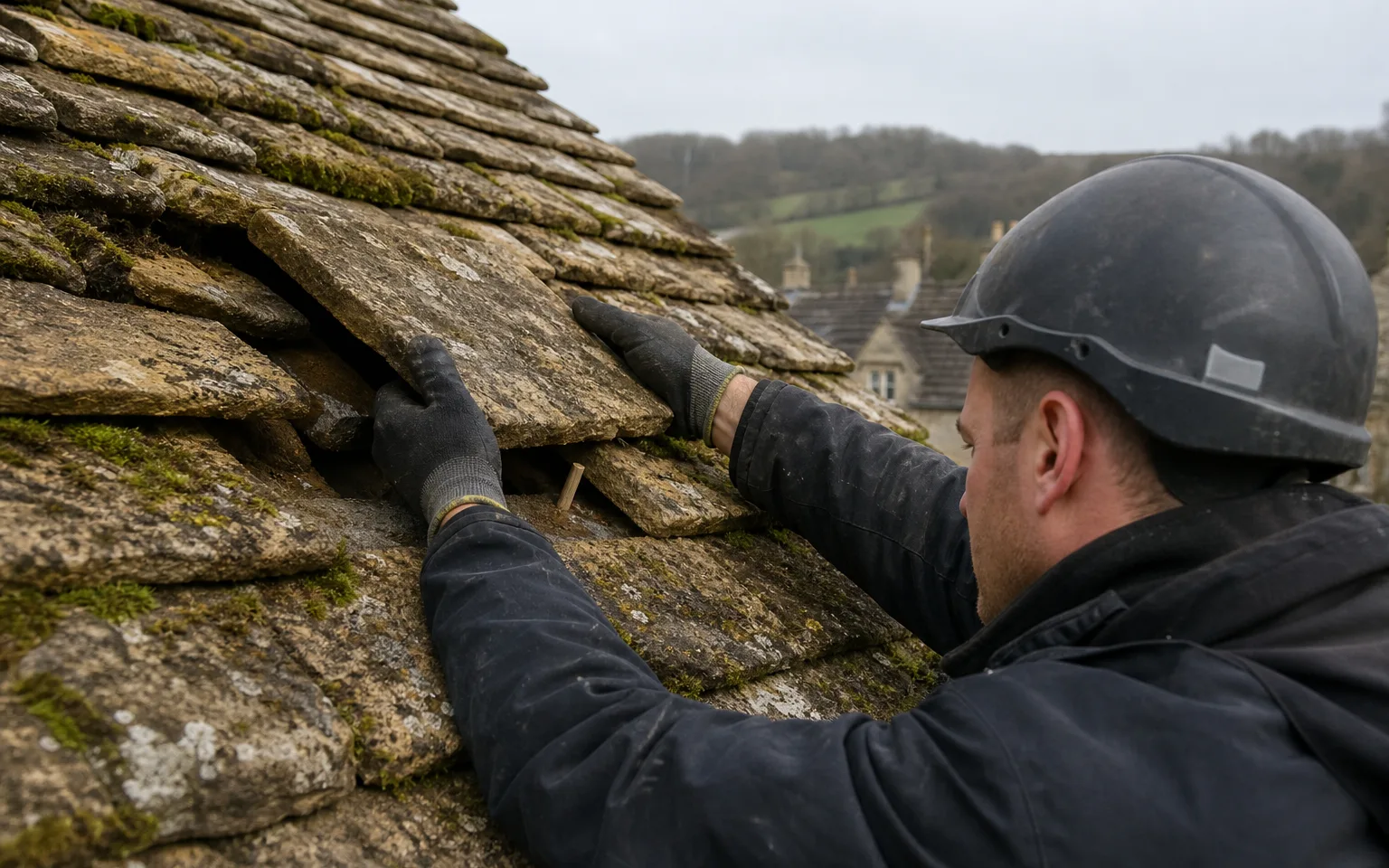
Traditional roofs of this type are simple straight pitches, typically between 47 and 55 degrees. That is a description of how they were built and not a minimum for any new work. A wooden peg, normally cleft oak, holds every slate: it is threaded through a drilled hole at the top of the stone and the slate is hung from a batten. In our experience a rotted peg is one of the first things to look at on a slipping roof, because a single failure lets one slate drop and loosens its neighbours.
Weight is the other quirk. The same guidance gives stone slate at about 1000 kg per 10 square metres, and Approved Document A treats a covering that is around 15% heavier as a trigger for a structural check, so changing the covering is never a casual decision. Stone also tends to lose slates to frost and age over generations. The guidance also says that about half the slates can have perished by the time an old roof is finally stripped, though every roof wears differently and only a survey shows how yours has fared. Our Cotswold stone roofing page covers repairs in more depth.
A stone-slate roof is a ledger: the courses have to add up.
- 1627year Sir Baptist Hicks built the Grade I Market Hall
- 1902year the Guild of Handicraft moved to the Old Silk Mill
- 1401year wool merchant William Greville died
Chapter 02
Three Grade I neighbours and the paperwork they bring
Which permission applies depends on what the building is and who looks after it.
Chapter 02In this chapter
A High Street with a Grade I market hall and a Grade I merchant's house is a street where assumptions are risky. A like-for-like re-roof that does not materially change a building's appearance is not usually counted as development, which is welcome news for a plain repair. If your own house is listed, though, any works touching its character need listed building consent from Cotswold District Council. Inside the conservation area, a change of covering or a new roof feature should be raised with the planning team before an order is placed.
In this chapter
St James' Church sits under a different system. While it remains a place of worship, the building comes under the ecclesiastical exemption, which means the diocese grants a faculty for roof work and the council's listed building consent is not the route. A chapel that has been converted to a home, or a church building no longer used for worship, usually falls back to ordinary consent from the council. If you look after a building in that position, tell us which side of the line it falls on when you get in touch.
Sourcing is the other half of the consent question. English Heritage's stance, as the council's guidance quotes it, favours freshly quarried stone over salvaged pieces, and wants reclaimed slates kept for the building they came from. It adds that replacements should match in rock type, colour, grain, size and thickness, and that sandstone and limestone must never be swapped. Fibre-resin, concrete and reconstituted substitutes are called inappropriate for historic buildings. On a Campden roof that translates into one working rule: identify the stone first, keep every sound slate, and quote matching stone for the rest.
What the survey writes down
Our survey records the roof from ridge to eaves with photographs of your own slates, noting dropped courses, failed pegs, weathered flaunching, which is the mortar fillet around a chimney pot, and the state of any lead. It becomes a written quote covering scaffold, stripping, new stone, labour, waste and making good. On a listed building we add a short list of points to confirm with the council before the first slate comes off.
Insulation on a stone roof
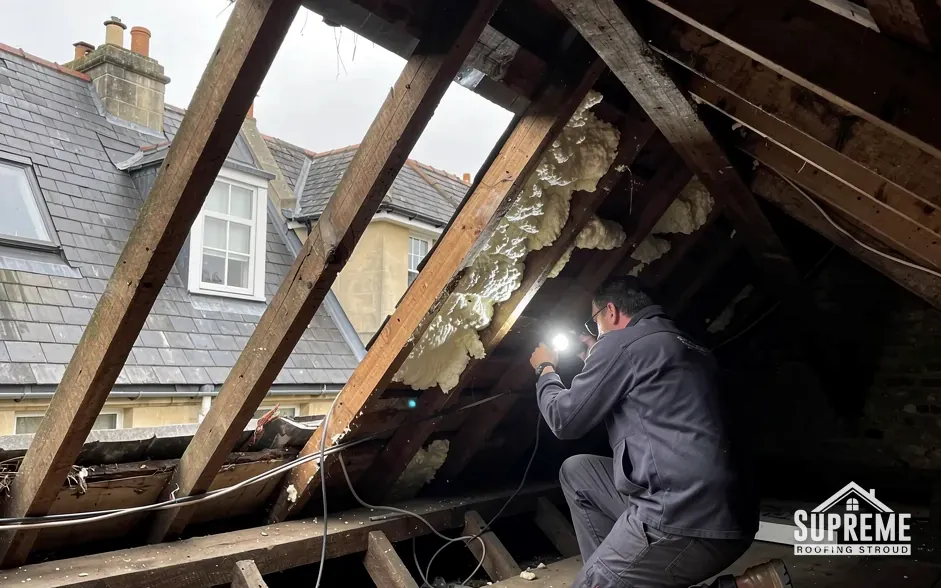
People often ask about insulating while the roof is open. RICS says sprayed foam is not reversible and is unlikely to be granted consent on a listed building, so on a street like this, think hard before choosing anything that cannot be taken out again. Our roof inspections and surveys page explains what a written report covers.
Chapter 03
From Stroud to the north Cotswolds: planning a long trip
Chipping Campden is a journey, so the survey does most of the work before a van is loaded.
Chapter 03In this chapter
Chipping Campden is about 39.5 road miles north-east of Stroud, further than most of the places we work in. We plan for that rather than hold back a quote. We ask for photographs and a short description of the roof first, which lets us spend the visit on the slates themselves and not on guesswork, and we group the survey, the stone order and the start date so that crews are not driving for small gaps in the programme.
A terraced frontage decides the access. A scaffold on a street frontage stands on the public footway or in the carriageway and needs the highway authority's permission, so we apply the moment you accept the quote. Stone slate is heavy, so the scaffold boards are sized for it, and old slates are lifted off by hand, sorted into sound and unsound piles and re-used wherever they pass. That sorting is slow labour, and it is one of the reasons a stone roof costs what it does.
Weather is handled by sequence. A stone roof is stripped in sections and sheeted every evening, because open rafters in rain turn a repair into a larger job. The quote covers scaffold, stripping, new stone, labour, waste and making good. It also says plainly if a section may need extra stone once it is open. If building control needs notifying, we handle that, then take the waste away and clear the site.
Chimneys and lead on a stone roof
Stacks and their lead flashings are where a stone roof tends to let water in first, since a rigid slate meets a soft metal at a joint that moves with temperature. A survey here always includes a close look at each stack, the flaunching around the pots and any lead at abutments, and our chimney repairs page explains the repairs that follow. Stone stacks are heavy as well, so any rebuild needs a proper scaffold platform around it before work begins.
One more practical point on a street with several owners: a party wall or a shared stack means two households have a stake in the same repair, and agreeing who pays for what is easier before the scaffold goes up than after.
Typical UK costs, before we visit
National guides give a sense of scale. Stone slate generally runs at about £160 to £210 per m², with origin, new stone against reclaimed and your location all moving the figure (Checkatrade, 2026). Treat that as a national range, not a Cotswold figure and not our quote. It gives you the scale, and the survey replaces it with real numbers. The table below sets other typical UK ranges beside it.

A long drive is measured and planned for at the survey.
| Job | Typical range | Source |
|---|---|---|
| Stone slate re-roof | £160 to £210 per m² | Checkatrade, 2026 |
| Natural slate re-roof | £100 to £180 per m² | MyBuilder, 2026 |
| Single slate repair | £60 to £120 | MyBuilder, 2026 |
| Repointing a chimney | £500 to £2,000 | MyBuilder, 2026 |
Map showing Chipping Campden and the Stroud service radius, with nearby towns we also cover.
Near Chipping Campden
Roof work we do here
Market Hall and wool church limestone in Chipping Campden
My cottage backs onto the High Street's Grade I buildings. Does that change how a stone slate repair is done?
Not the method, but it raises the care. If your own house is listed, works that affect its character need consent from Cotswold District Council. If it is unlisted, a repair in matching materials is normally simple, but the conservation area means a change of material needs a word with the planning team first.
Can old Cotswold stone slates be re-used on a Chipping Campden roof?
Sound slates from your own roof can usually go back on it. English Heritage policy, as reproduced in the council's 2000 guidance, keeps reclaimed slates for the building they came from, and asks new ones to match the old in stone type, colour, size and thickness.
How do you handle a church or chapel roof here?
It depends on use. A church in use is under the ecclesiastical exemption and needs a faculty from the diocese. A converted or redundant chapel normally needs listed building consent from the council. Tell us which it is and we plan the survey around the right route.
Will the long drive from Stroud push the price up?
Travel and the programme are worked into the written quote, not added on the day. Sending photographs first lets us cut the number of visits.