
Roofers in Sherston
Roof work in Sherston, the southern Cotswold village beside the infant River Avon, where a 1511 fire, a Grade I church and a 1973 conservation area all shape what can be done.
Sherston at a glance
- Distance
- 15 road miles south of Stroud
- Council
- Wiltshire Council
- Conservation area
- Most of the village, designated 1973
- Listed buildings
- 54 in the conservation area
Sherston's roofs, rebuilt after the fire of 1511
Sherston lies 15 road miles due south of Stroud, beside the infant River Avon on its way to Malmesbury. The parish sits within the Cotswolds National Landscape, the designation formerly called an Area of Outstanding Natural Beauty. Southward from Stroud, the hills open out and the road drops toward the Wiltshire border.
The village is old. The earliest surviving record of Sherston, as Scorranstone, is an Anglo-Saxon document of 896, and a weekly market was held from 1241 or earlier. A fire in 1511 destroyed most of the village's buildings, so the street you walk down today grew back from that loss. The Church of the Holy Cross is Grade I listed, and the Court House on Court Street, rebuilt around 1680, is Grade II*.
Most of the village was designated a conservation area in 1973, by a Wiltshire County Council order published that April. According to HeritageCheck, which cites Historic England data, it holds 54 listed buildings: one Grade I, four Grade II* and 49 Grade II. Protected fabric on that scale means listed building questions arise on many Sherston jobs, so we raise them at the first visit.
Roofs in a village rebuilt over five centuries differ along every street, and our survey records what covers yours, and the photographs show it. Planning here sits with Wiltshire Council, whose planners are worth ringing before you change a listed or protected roof.

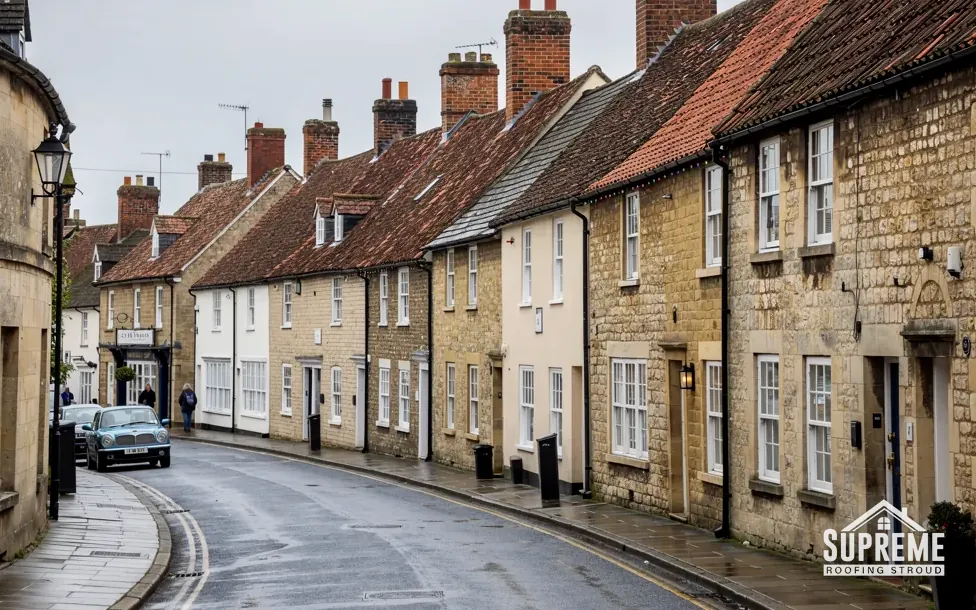
Victorian terraced houses with slate roofs and chimneys on a hillside 
Flint and brick cottage with a clay tile roof beside a road

Chapter 01
After the 1511 fire: a village rebuilt on its old lines
The fire destroyed most of the buildings, and the listed roofs of today carry five centuries of repair.
Chapter 01In this chapter
A fire in 1511 destroyed most of Sherston's buildings. The market, the church and the streets around them survived as places, and the village was rebuilt around them. That history matters to a roofer because it means the buildings on a given street come from several centuries, with later alterations on top. The Court House was rebuilt around 1680, which makes it a house of the later 17th century, and the Church of the Holy Cross is far older.
The listing figures tell the same story in numbers. HeritageCheck counts 54 listed buildings within the conservation area: one at Grade I, four at Grade II* and 49 at Grade II. Most of Sherston's list is Grade II, and the grade does not change the basic principle. Listing law is the same in Wiltshire as across England: whatever the grade, every part of a listed building is covered, the interior as well as the facade.
For a roof, this has practical effects. Wiltshire Council must grant listed building consent before work starts that would change a listed building's character, and going ahead regardless is an offence. The test is character, not size. Re-covering in another material or adding a rooflight may need consent where a straight like-for-like repair would not. Unsure if you are listed? Check with the council first, and we will work from whatever answer comes back.
Court Street and the Court House
The Court House on Court Street, rebuilt around 1680, is Grade II*. A house of that standing is an example of what a listed roof asks of its owner and its roofer: a repair method agreed with the council, a covering chosen to match what is there, and records of what was done. When we survey a listed roof we write down the covering, its fixings and every detail of the ridge, verges and eaves, and we photograph them. If consent is needed, those notes and pictures are what you hand to the council. They can save weeks of back and forth.
The church roof
The Church of the Holy Cross is Grade I. For roof work on a church holding services, the faculty comes from the diocese, not the council. Outbuildings and curtilage structures are worth checking with the council's conservation officers, since their status is not always obvious from the street.

Reading a rebuilt village
On older houses we look for signs of earlier repairs: different slates in one area, a patch of cement, a ridge laid again on a mortar of a different colour. These often tell more about a roof than its age does. We mark them on the photographs so you can see where past work has been done and decide what to do about it.
A roof that has survived since a rebuild deserves a careful survey before a quote.
- 54listed buildings in the Sherston Conservation Area
- 1511year a fire destroyed most of the village's buildings
- 1973year most of the village became a conservation area
Chapter 02
Stone slate care in the National Landscape
Where a stone roof is protected twice over, regular upkeep is the lowest-cost repair.
Chapter 02In this chapter
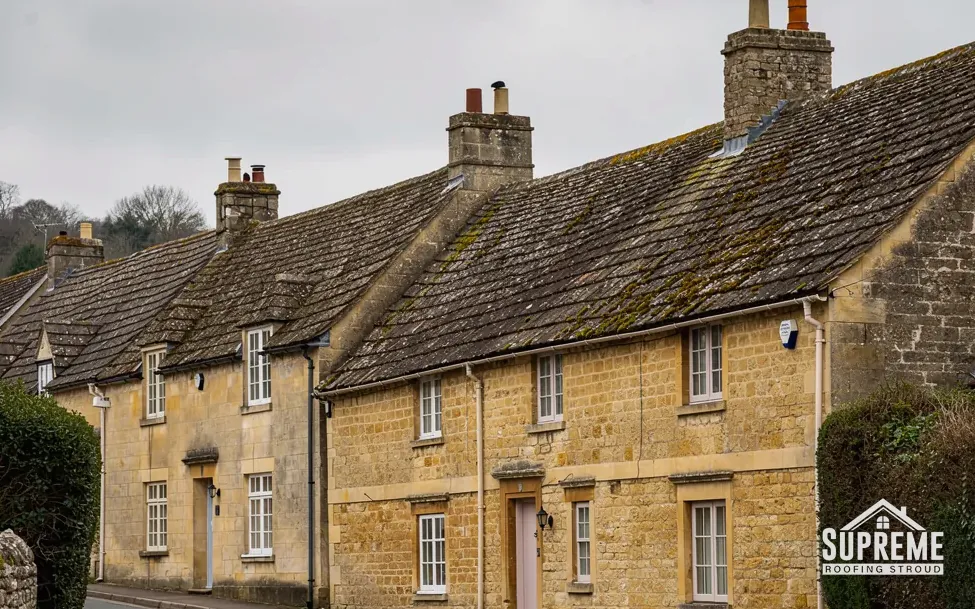
Sherston stands in the southern Cotswolds, and a useful traditional reference for the craft is Cotswold District Council's stone slate guidance. It dates from 2000, so we treat it as past practice, not current supply. Its claim is bold: kept up, a Cotswold roof can easily reach a century and might reach 200 or 300 years, and annual scraping of moss could double a roof's life. The lesson is that stone, looked after, is no short-life product.
In this chapter
If your roof is stone, what we do on site follows from that. We clear moss and debris from the valleys and gutters, replace the pegs or fixings that have failed, reseat slipped slates and check that the lead in the valleys and around chimneys is sound. Valleys deserve special attention. The guidance describes traditional swept valleys built from specially cut slates, and says closed-mitre or open lead valleys are cheaper but are best avoided. We note which type you have before suggesting any change.
Costs depend on the stone and the source. Checkatrade (2026) gives roughly £160 to £210 per square metre for stone slate in general, a spread driven by the stone's origin, new against reclaimed, and the region. It is a general figure, not a Cotswold installed price, so the survey and the quote narrow it down for your roof. Our Cotswold stone roofing page gives the wider picture.
What a stone roof survey records
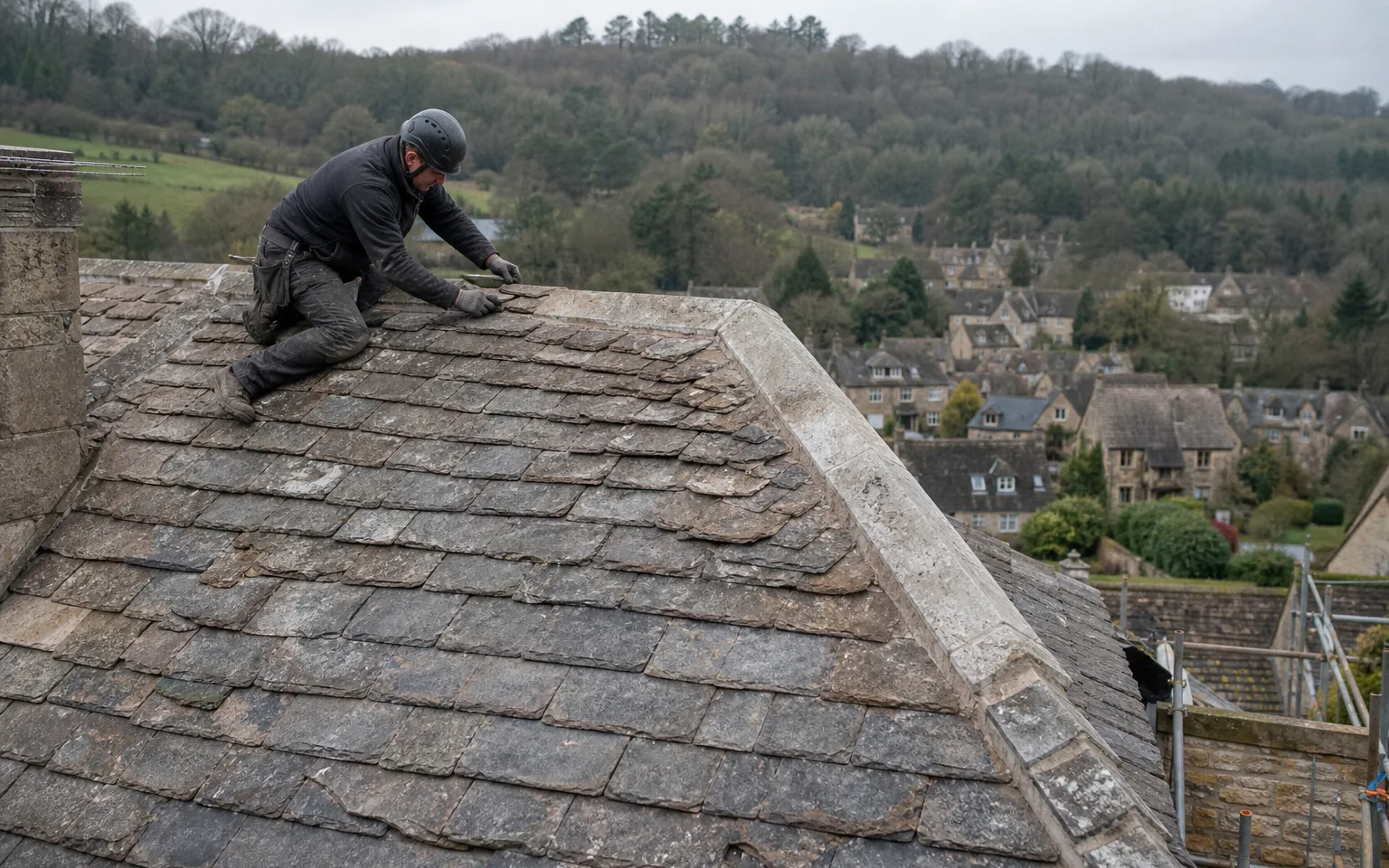
On a stone roof we look from the ground first, then at close range. From a distance a sag in the ridge or a dip across a slope suggests that timbers beneath have moved. Up close we check for slates that have slid, slates that have split along their beds, and slates held by one peg where there should be two. Inside the roof space we hunt for chinks of daylight, stained timber and rafters that bow. A previous repair in a mismatched material is a clue too: a smear of cement usually means somebody has already chased a leak.
Permissions in a protected village
Sherston has overlapping designations: a conservation area, many listed buildings and the National Landscape. In a conservation area or the National Landscape, dormer additions are not permitted development, so they need planning permission. Wiltshire Council can say whether any Article 4 direction affects roofs on your street, so ask before planning a visible change. For roof windows, our roof window planning guide explains the rules, and we will tell you what applies to your property.

New stone or salvage
The 2000 guide also sets out English Heritage policy on sourcing: new stone where possible, and salvaged slate only on the building it was removed from. In a quote, new stone is named, which shows what it adds.
| Property | Authority | What it means for a roof |
|---|---|---|
| Listed house | Wiltshire Council | Listed building consent for changes that affect character |
| Church in use | The diocese | A faculty authorises roof work |
| Unlisted house in the conservation area | Wiltshire Council | Like-for-like repair is routine; ask before altering the look |
| Dormer or large addition | Wiltshire Council | Planning permission needed in this designation |
Chapter 03
Silk ribbons, the Avon and the commercial roofs of a market village
A weekly market and a silk mill show that Sherston has always had working buildings, not just homes.
Chapter 03In this chapter
Sherston held a weekly market from 1241 or earlier. A silk mill run by Joseph Davenport and Sons opened in 1872 to weave silks and ribbons, and it closed in 1922. The history makes one thing plain: this village has long had commercial and working premises alongside its houses.
Today that means shops, pubs, workshops, farm buildings and halls, each with a roof that has to carry on working. Commercial roofs often differ from houses in three ways. They tend to be larger, they have more drainage to look after, and they are in use during the day, which makes access and timing matter. A leak over a shop counter or a hall floor costs far more than the tiles above it, so the make-safe comes first.
Our order of work is to stop the water coming in first, and a leak or storm damage goes straight to the front of our list. The survey and its photographs follow, then a written quote covering access equipment, strip-out, materials, labour, waste and making good. Our commercial roofing page explains the main systems, and our roof repairs page covers leaks and storm damage in more detail.
Flat roofs and extensions at the back
Shops, pubs and halls often have a flat or low-pitched section behind the stone frontage. These roofs tend to be covered with built-up felt, EPDM, GRP or single-ply membranes, and they fail at their edges, at upstands and at outlets more often than across the middle of the sheet. MyBuilder (2026) puts flat roof lifespans at 15 to 30 years generally. We check how the membrane is lapped and sealed at the junction with the stone wall, because a flat roof that meets a masonry face without a proper upstand and flashing will let water in however good the membrane is.
Water close to the roof
The infant Avon runs beside the village. Streams and damp ground mean that gutters and downpipes carry more than their share of the load. We check that outlets run clear and that water is carried well away from walls, especially where an older stone wall has no damp-proof course.
What you will receive
The survey photographs are yours, and our workmanship carries a 10-year guarantee in writing. To arrange a survey visit, ring 01453 933613, drop us a WhatsApp or fill in the enquiry form here.
Map showing Sherston and the Stroud service radius, with nearby towns we also cover.
Near Sherston
Roof work we do here
The 1511 fire and 54 listed buildings in Sherston
How can I tell whether my Sherston house is among the 54 listed buildings?
The council's planning team can confirm it, or you can search the national list by address. For a listed house, changes touching its character need listed building consent, and we plan the repair around that.
Can a stone roof in Sherston really last 100 years?
Cotswold District Council's guidance says a well-maintained Cotswold stone roof can easily last 100 years. Moss, blocked valleys and failed fixings shorten that, so regular checks matter more than the date on the roof.
Is a dormer allowed on a house in Sherston's conservation area?
Permitted development does not stretch to dormers in a conservation area or the Cotswolds National Landscape, so Wiltshire Council must grant planning permission. Roof windows are treated differently.
My shop roof in Sherston has started leaking. What happens first?
Leaks come first for us, and we make the roof safe before anything else. A survey with photographs of the cause follows, then a written quote for the lasting repair.