

Roofers in Lea, Herefordshire
Roofing for a Herefordshire village that was once partly in Gloucestershire, where the A40 runs through, the church is Grade II* and the paperwork goes to a different council from ours.
Lea, Herefordshire at a glance
- Distance
- 21.5 road miles north-west of Stroud
- Council
- Herefordshire Council
- Setting
- South-east Herefordshire, on the A40 at the Gloucestershire border
- Listed church
- Parish church, Grade II*, restored 1854
The roofs of Lea: a border village on the Ross to Gloucester road
Lea lies in south-east Herefordshire, south-east of Ross-on-Wye, right on the county boundary with Gloucestershire. The A40 between Ross and Gloucester runs through the village, and anyone who has driven that road has passed the houses we are talking about.
Its history is oddly tangled. The township of Lea Lower, which held the parish church, was an exclave of Gloucestershire until the Counties (Detached Parts) Act 1844 moved it to Herefordshire. Lea Upper and Lea Lower were united in 1883. From 1855 to 1964, Mitcheldean Road railway station served the village.
Lea's parish church carries a Grade II* listing and the dedication of St John the Baptist. It was restored in 1854 and has a marble font of about 1200, of south Italian origin, given in 1909. Grade II* sits just below Grade I, so the church counts as a particularly important building of more than special interest, and anything built or altered near it is looked at with that in mind.
Together these details describe the place well: a roadside village on a boundary, with a church at its heart, buildings from several periods, and a county line that decides whose planning team you speak to. We read each roof on its own evidence at the survey, at ground level and under the rafters, and we never assume a house matches its neighbour.
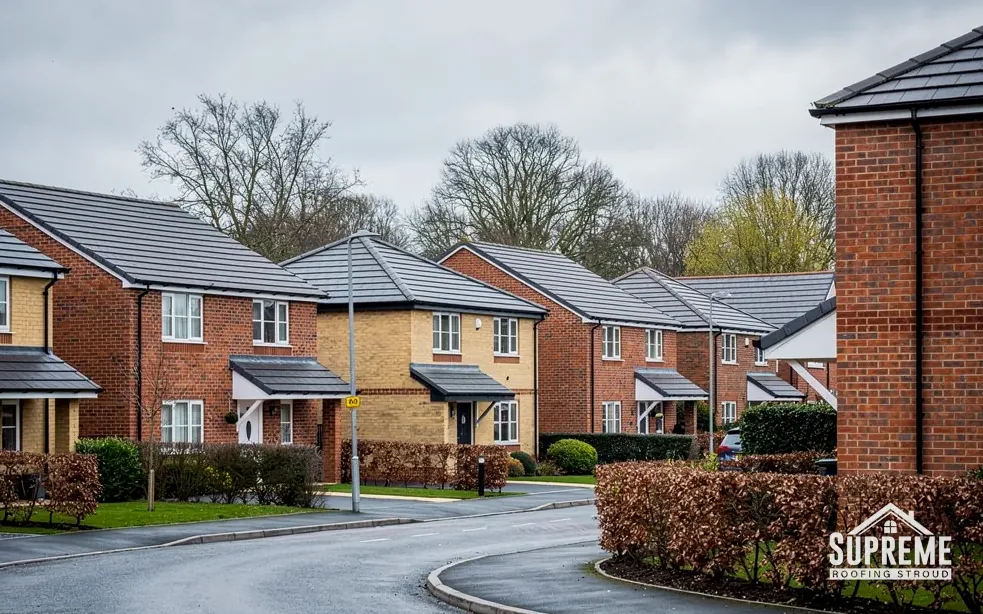
Modern brick housing estate with grey tiled roofs along a curving road 
Hillside of stone terraced houses with mossy stone tile roofs and chimneys

Chapter 01
A Gloucestershire exclave until 1844: whose rules cover a Lea roof
The county line decides which council reads your plans, even though your house is a short drive from the Gloucestershire boundary.
Chapter 01In this chapter
Part of Lea once belonged to a different county. Lea Lower was cut off from the rest of Gloucestershire and surrounded by Herefordshire until the Counties (Detached Parts) Act 1844 transferred it. For a roofer that is a practical point and not a curiosity. Anyone working from Stroud is used to Stroud District Council and the shared building control service that sits with it. Lea answers to Herefordshire Council, and its planning and conservation officers, not ours, are the people to ask.
In this chapter
So we do not carry Stroud's rules across the boundary. When a Lea job touches planning, whether that is a listed building, a visible change to the roof, or a proposed dormer, we send you to Herefordshire Council's planning team and explain what to ask. Building control works on national rules. A re-roof normally escapes Building Regulations approval only while it touches less than 25% of the building envelope and less than 50% of the roof, and a new covering that adds 15% or more to the weight needs approval and a structural check. The inspecting body can be the council or a registered building control approver.
Getting the order right
A boundary job follows a fixed sequence. We start with a visit and a set of pictures taken at the eaves, on the slopes where it is safe, and in the loft. The written quote follows, covering the job from access to clearance. If the council's consent comes into it, we outline how to apply and what officers tend to want to see. A start date is agreed last.
Documents to have to hand
If your house or its plot has any history of planning or building control, it helps to have the paperwork out before the survey: an earlier consent, a completion certificate for a loft room, or the guarantee for a previous roof. None of it is essential, but it spares you a round of questions, and it tells us at once whether an earlier owner changed the structure in a way that affects what we can fit.
Distance
Lea is 21.5 road miles north-west of Stroud, so a Lea job is a planned trip and is scheduled with that in mind. Our roof inspections and surveys page describes what the first visit covers, and it is a good place to start if you do not yet know whether you need a repair or a replacement.
None of this makes a Lea job harder than any other. It means the first conversation includes the question of which council you are dealing with, and the quote records the answer.
The county line decides which planning team you ring.
- 1844year an Act transferred Lea Lower from Gloucestershire to Herefordshire
- 1883year Lea Upper and Lea Lower were united
- 1855 to 1964years Mitcheldean Road station served the village
Chapter 02
Working beside the A40 through Lea
A main road at the garden gate changes how scaffold, deliveries and skips are arranged.
Chapter 02In this chapter
The A40 runs through Lea, and a good many of the village's houses face it. That has no bearing on what a roof is made of, but it has a lot to say about how a roof is worked on. A scaffold that stands on the pavement beside a main road is a different undertaking from one on a quiet lane, and so is the loading and unloading of a lorry.
In this chapter
Before anything is erected we look at where it can safely stand. If the scaffold or a skip must occupy the public highway or footway, a licence from the highways authority is needed first, and that takes time, so the application goes in as soon as you agree a start date. If there is a drive, a yard or a side access, we use it for materials and waste so the road itself stays clear. On the written quote the scaffold is allowed for, and any licence fee with it, so nothing is hidden.
Noise, dust and the public matter too. Cutting and stripping beside a main road sends debris towards passers-by, so we net the scaffold, protect the pavement and keep the work area closed off. Waste goes into a skip or straight onto a vehicle, never into a heap in the road, and the pavement is swept at the end of every working day.
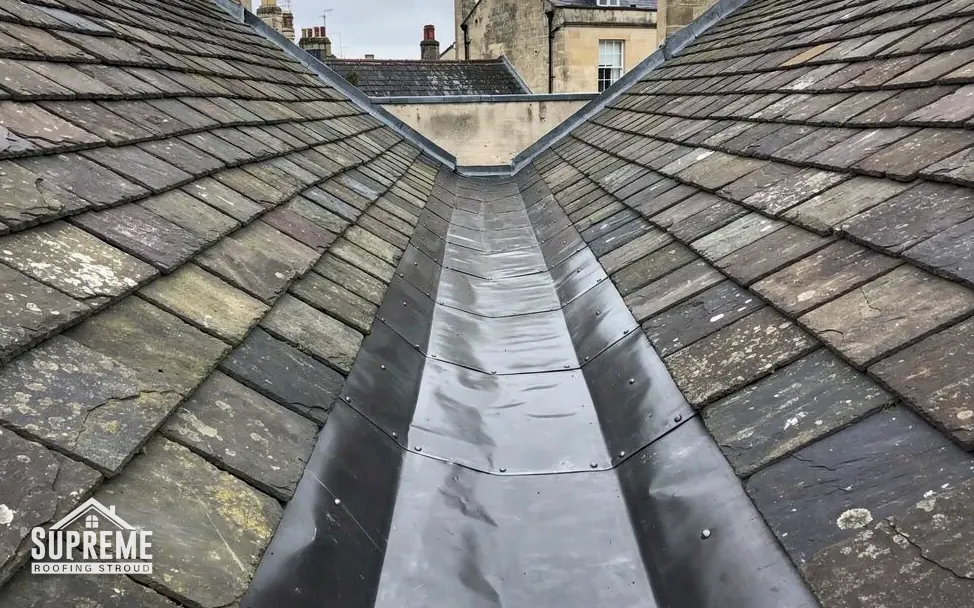
Chimneys facing the road
Many roadside houses have a chimney stack close to the front elevation, and stacks are where a survey often finds the first signs of trouble. The usual faults are cracked flaunching, a lifted flashing and pointing that has eroded. Our chimney repairs page explains how each is repaired. For a stack that faces a busy road, the work is planned so that tools and debris never pass over the pavement: a sheeted scaffold with a debris chute takes the waste down.
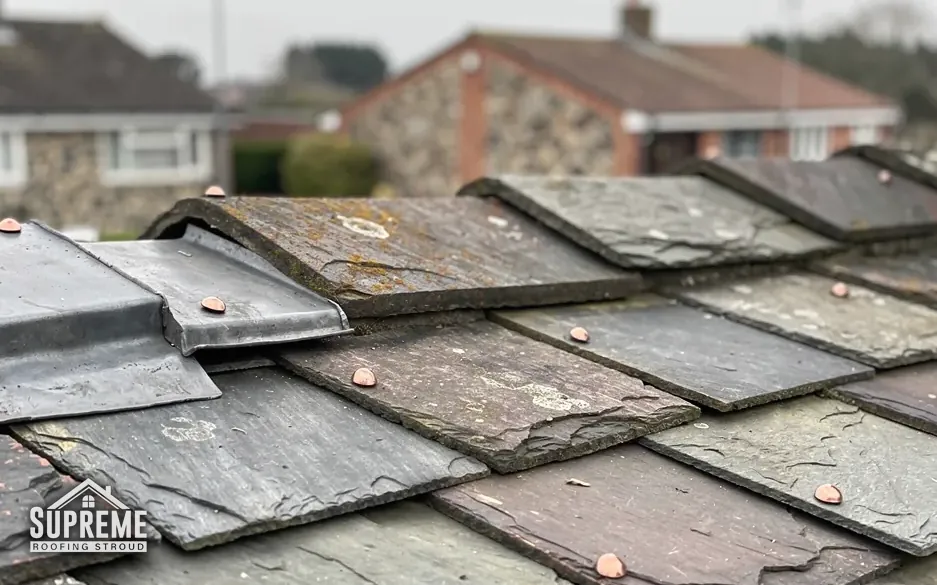
Deciding between repair and re-roof
The quote shape stays the same whichever you choose. If the covering is sound but a few components have failed, a repair is the sensible path. If it is failing across the slope, a full re-roof is the better answer than patching the same slope again. Our roof replacement page explains what a strip and re-lay involves. As a national guide, MyBuilder's 2026 new roof cost page puts a full re-roof at £5,000 to £12,000, with scaffold about £1,125, which shows how much of a total access is likely to be before we visit.
Where a roof is replaced, the old covering is cleared away with the scaffold, and the site is left tidy.
Chapter 03
Lea's Grade II* parish church and its restoration of 1854
A restoration is a layer of earlier repairs, and a roof survey reads those layers.
Chapter 03In this chapter
Lea's church was restored in 1854, and it holds a marble font of south Italian origin, about 1200 in date, given in 1909. Those three dates, 1200, 1854 and 1909, describe a building altered, repaired and added to over several centuries. That is how most old buildings arrive in our hands: not as a single design, but as a sequence of repairs.
In this chapter
A restoration in the 1850s means the church was reworked, and any roof over it may carry the marks of more than one campaign. We apply the same thinking to houses. A roof that has been patched, re-covered in part and extended is a record, and a good survey reads it before proposing anything. We note where the covering changes, where the timber is old and where it is new, and which repairs have lasted. Photographs of those places go into the quote.
What Grade II* means here
Of the three listing grades, II* ranks above II and below I. Because the church is still used for worship, the exemption for ecclesiastical buildings applies, and its roof goes through the diocese by faculty instead. A house or outbuilding in the village that is itself listed follows the usual route, and the council's conservation team is the place to ask. A call before any roof work saves a good deal of correction later.
Myth: A restored old building has had its repairs done once and does not need to be looked at again.
Fact: A restoration adds a layer to the building's history, and roofs and stacks from that campaign still need an eye kept on them like any other.
Learning from older repairs
The useful lesson is about like-for-like. When an old roof is repaired, the best repair matches the original in material, size and detail, so that the building keeps its character and the next owner can see what was done. Where a house is not listed, you can choose freely, but we still recommend keeping to the existing covering unless there is a clear reason. Our chimney repairs and survey work sit well together on older houses, since the stack is the part most often rebuilt in a different generation from the roof.
The written quote sets out the repair method, so you can decide what to authorise. If a lead flashing, a ridge or a section of verge has been repaired badly in the past, we show it in a photograph and explain how the fix will differ, since a second poor patch on top of the first only hides the problem.
Photographs are also what let a distant owner or a landlord judge a job without standing on the roof. They go with the quote, one set before work starts and one set after, so the before and after are both on record and the finished repair can be checked against the original fault.
Map showing Lea, Herefordshire and the Stroud service radius, with nearby towns we also cover.
Near Lea, Herefordshire
Roof work we do here
A40 frontage and the Grade II* church in Lea
Lea used to be in Gloucestershire. Which council do I deal with for my roof?
Herefordshire Council. Lea has been in Herefordshire since an 1844 Act moved Lea Lower across the boundary, so planning questions go to its planning team. We describe the national thresholds and leave local consent to them.
My house faces the A40. Can scaffold go on the pavement?
Often, but not without a licence from the highways authority. We look at the frontage at the survey, plan where scaffold, skips and deliveries will stand, and apply early so the licence does not hold up the start date.
Is a Grade II* church roof something I can ask you to repair?
Church roofs in use are authorised through the diocese by faculty, so that process belongs to the parish. We can survey and quote for houses and other buildings nearby, and explain the consent route for any that are listed.
How do you decide whether a Lea chimney needs repointing or a rebuild?
We inspect the flaunching, flashing and joints from a ladder or scaffold and photograph what we find. Sound masonry with worn joints is repointed. A stack that leans or has lost its structure is rebuilt, and the quote covers each option.