

Roofers in Lacock
Roofing work in Lacock, 29.1 road miles south of Stroud, where five Grade I buildings, a conservation area and the River Avon shape every job before the first slate comes off.
Lacock at a glance
- Distance
- 29.1 road miles south of Stroud
- Council
- Wiltshire Council
- Conservation area
- Lacock (CA/N/122)
- Setting
- Avon valley south of Chippenham
Lacock's roofs between the Abbey, St Cyriac's and the River Avon
Lacock is a village where the roof above your head is probably older than the rules about how to mend it. The River Avon crosses the parish from north to south, and the village lies in the Avon valley south of Chippenham. Ela, Countess of Salisbury, set up Lacock Abbey in 1232, and in 1944 Matilda Talbot gave the abbey and the village to the National Trust. For a roofer that history matters for one plain reason: a great many buildings here are protected, and the protection reaches the roof.
The parish has five Grade I buildings: Lacock Abbey, St Cyriac's Church, the 14th-century tithe barn, Bewley Court and Bowden Park. King John's Hunting Lodge and The Sign of the Angel are among the village's Grade II* listed buildings, and Lacock has a designated conservation area, recorded by Wiltshire Council as CA/N/122. St Cyriac's goes back to the late 11th century, so its roof sits on walls and timbers of very different ages.
The village is owned almost in its entirety by the National Trust, so the landlord's say matters as much as the council's. What we can describe is the order of work. A survey here begins with status: is the house listed, does it stand inside the conservation area, and does anyone else, a landlord or an estate, have a say? The covering comes last. We photograph the slopes, valleys and abutments and write up what needs doing in order of urgency.
If the building is protected, we price like for like, and we tell you early when something looks like a change that needs consent.

Stone terraced houses with slate roofs and chimneys stepping up a hill 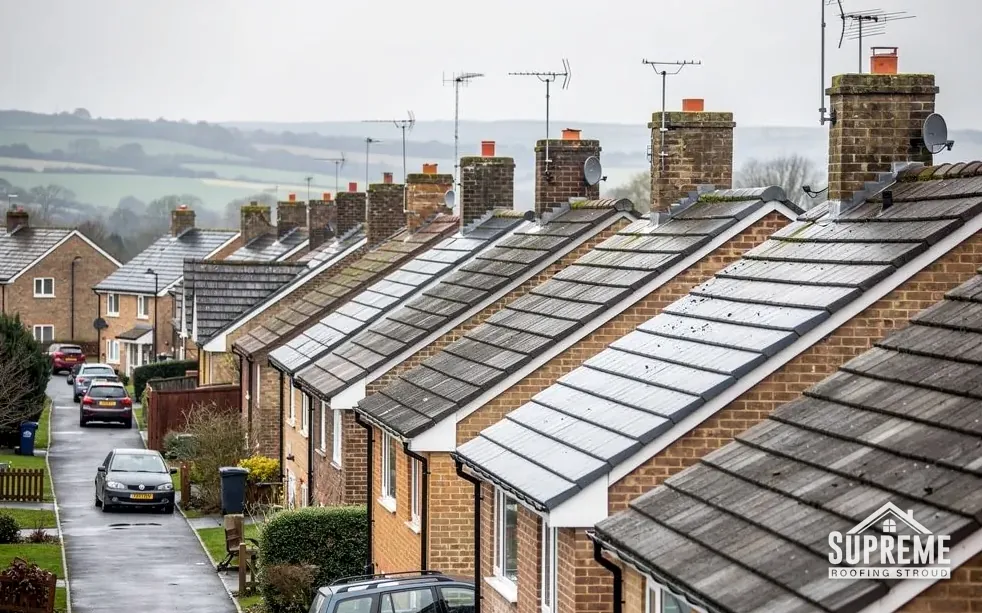
Terraced houses on a hillside street with tiled roofs and brick chimneys
Chapter 01
Five Grade I buildings in one parish
When the neighbours are listed at the top grade, consent questions come before roofing questions.
Chapter 01In this chapter
Few villages of Lacock's size carry five Grade I listings, and the list is worth reading slowly: the abbey, St Cyriac's Church, the tithe barn, Bewley Court and Bowden Park. The 1990 legislation on listed buildings, at section 7, forbids changes that touch the historic or architectural interest of a listed building unless permission is already in place. Stroud District Council's own guidance makes the practical point that protection covers every part of the building, interior and exterior, at any grade. Lacock falls under Wiltshire Council, but the principle is national, so the first call about a listed roof goes to the conservation officers and not to a scaffolder.
What counts as alteration is the question that decides a quote. A new covering in the same material and method is normally repair. Swapping slate for a tile, changing the pitch, or replacing a hand-cut detail with a factory-made one is a different conversation. We price like for like and mark it on the quote. Where a change would be needed, we put it in writing as a question for the council, not as a decision taken on your behalf.
The tithe barn and its neighbours
The tithe barn is described as 14th-century, which makes its roof frame one of the oldest working structures in the village. Big historic barn roofs have long spans, heavy timbers and a great deal of covering. A leak at one corner can come from a gutter, a failed abutment or movement in the frame, and from the ground those look alike. Our survey of a building like that records the roof in sections, so the later schedule of works maps back to photographs rather than to memory.
A lower grade is still protected
King John's Hunting Lodge and The Sign of the Angel are listed Grade II*, as the Historic England list entry records. A lower grade does not mean lighter protection, because consent rules apply to every listed building. It does mean owners need guidance on process more than on technique. Survey and photographs come first, a like-for-like specification second, then pre-application advice from the council, and only after that a start date. Our written quote has one price for scaffold, stripping, the new covering, labour, the skip and any carpentry, so a conservation officer reading it can see exactly what is proposed.
A listed roof is priced once its status is known.
- 1232year Lacock Abbey was set up by Ela, Countess of Salisbury
- 1944year the abbey and village were given to the National Trust
- 5Grade I buildings in the parish
Chapter 02
The Avon valley and reaching a Lacock roof
A protected village needs its scaffold and its storage planned as carefully as the roof.
Chapter 02In this chapter
Lacock lies 29.1 road miles south of Stroud, close to the outer edge of the area we cover. The distance shapes how we work: a survey here is planned as one visit with ladders, camera and a full look at every slope, not a quick glance followed by a second trip. The village sits in the Avon valley south of Chippenham, and the river crosses the parish from north to south.
A protected village changes how scaffold is planned. Where a house fronts straight onto the road or a footway, the scaffold may need a licence from the highway authority, and that timing is built into the start date. Where a building has a garden or yard behind it, we look at the route the materials will take and how the old covering will come out, because every bucket crossing a lawn, a path or a historic surface is a point where damage can happen. On a listed building we cover and board vulnerable surfaces before anything is lifted, and the quote shows what that protection costs. We photograph the existing surfaces before work begins, so any later question about condition can be answered from the record rather than from recollection.

What a river-valley setting means for a survey
Rainfall and flooding are not ours to predict; what we can control is the route water takes off the roof. We look at the parts of the roof that carry water away. Gutters, hoppers, downpipes and the gullies they discharge into are the first things we photograph, since a roof that cannot shed water cleanly passes its problems to the wall below, and old walls take a long time to dry. If a gutter is overflowing onto a historic wall face, repairing the gutter often does more good than touching the covering. We tell you that, and we price only what the roof needs.

Where roof meets wall
Old buildings tend to leak at their junctions long before they leak across the open slope. Lead strips called flashings seal the line where a slope meets a stack or a gable, and small folded lead pieces called soakers are tucked beneath the slates or tiles alongside. Both are cut and dressed by hand, because old masonry is rarely square. When a survey finds a stain on a ceiling below one of these junctions, the likely cause is the flashing and not the covering, and the repair is correspondingly small. Our chimney repairs service covers the stack side of that story.
Where houses share walls and yards, we also agree access with neighbours before the scaffold goes up, so nobody finds a pole in the garden on a Monday morning.
Fix where the water goes before you decide what the covering needs.

Chapter 03
St Cyriac's, the conservation area and who signs off
Three different regimes can touch one Lacock roof, and each one has its own gatekeeper.
Chapter 03In this chapter
St Cyriac's Church goes back to the late 11th century and stands among the five Grade I buildings in the parish. As a working church, St Cyriac's sits outside the council's listed building consent system, and its roof work goes to the diocese for a faculty instead. A contractor on a church roof therefore quotes to a specification set by others, and our part is to price it so the people responsible can compare like with like.
That shelter ends when worship does: once a church stops serving as one, or becomes a home, the council takes over and listed building consent is normally needed, as for any other listed building. If you own a converted building in or near Lacock, check its status with Wiltshire Council before a roof specification is agreed.
The conservation area around it
Lacock has a designated conservation area. A straightforward repair that leaves a building's appearance unchanged seldom needs planning permission, but a listed building, or a home where a direction removes permitted development rights, is a different case. Changes to the shape of a roof are another matter. In a conservation area, dormer loft conversions are not permitted development, and roof windows have rules of their own, which our roof window planning guide sets out. Put the idea to Wiltshire Council's planners before a drawing exists.
Building Regulations on a protected roof
Planning protection and Building Regulations are separate things. Stay under both limits, 25% of the building envelope and 50% of the roof, and no building control application is normally needed. Go over either one and an application is required, with a possible thermal upgrade. On a historic building that upgrade deserves careful design, so it is raised at the survey. Where the job is notifiable, we handle the notification and talk you through what it means, then leave the plot tidy at the end. The workmanship carries a written 10-year guarantee, and our roof inspections and surveys page explains what the photographic report contains.
Map showing Lacock and the Stroud service radius, with nearby towns we also cover.
Near Lacock
Roof work we do here
Lacock Abbey, St Cyriac's and the Avon
Does a repair to a listed Lacock cottage roof need consent?
Repairs that match the existing covering and method are treated differently from alterations, but the test is whether the change touches what makes the building special, and the council makes that call. We photograph the roof, write a like-for-like schedule, and you can show it to Wiltshire Council's conservation team before any work is agreed.
Who authorises roof work on St Cyriac's or a church like it?
A church in use sits outside listed building consent and goes through a diocesan faculty instead. A redundant church or converted chapel has lost that shelter so the council would normally be asked for listed building consent. We can add a short note to the survey stating which route applies to your building. We price to whatever specification the authorising body approves.
Lacock is 29.1 road miles from Stroud. Does that change the quote?
Distance is something we plan for at the survey and show in the written quote like any other cost driver, so nothing arrives as a surprise. We combine the survey into one trip and photograph every slope so the report stands on its own.
What does a Grade I neighbour change about scaffolding in Lacock?
Scaffold ties, boards and material storage are positioned to avoid loading or fixing into historic fabric, and we agree where they can sit before the quote is written. If a footway is involved, the highway licence is applied for once you have fixed a start.