

Roofers in Corsham
Roofers in Corsham, the historic market town on the south-western edge of the Cotswolds, where Bath stone, a listed High Street and a mid-century population surge give roofers very different jobs.
Corsham at a glance
- Distance
- 28.7 road miles south of Stroud
- Council
- Wiltshire Council
- Conservation area
- Corsham Conservation Area
- Setting
- Above the Bath stone mines
Corsham's roofs: the High Street, Corsham Court and a town that outgrew its old streets
Corsham is a historic market town at the south-western edge of the Cotswolds, and it is also a town with two stories running side by side. One is the old centre: St Bartholomew's Church, which has 12th-century origins and was restored in 1875 to 1878 by G. E. Street, who added the tower, and which was listed Grade I in 1960. Corsham Court is based on an Elizabethan manor house of 1582, built by Thomas Smythe, and has been part of the Methuen estate since 1745. It is listed Grade I, and Capability Brown, John Nash and Thomas Bellamy all altered it in turn. The High Street has more than 60 listed buildings.
The other story is growth. The population rose from 3,754 in 1931 to 9,268 in 1951, an increase put down to military personnel. A town that more than doubled in twenty years had to be built quickly, and the houses, shops and outbuildings from that period are now old enough to need serious roof work.
Under both stories lies the stone. Underground mining of Bath stone extended south and west of the town, and quarrying continues on a smaller scale at Hartham Park and Monk's Park quarries. Bath stone is a limestone building stone, so it appears in Corsham's walls, parapets and copings. Whatever covers a given roof, the masonry matters to a roofer, because every flashing, parapet gutter and chimney is only as sound as the wall it joins.
That mixture of grand and ordinary is why we give each Corsham survey its own plan and its own photographs.

Flint and brick cottage with a clay tile roof beside a road 
Wooded hillside lined with rows of stone houses and slate roofs
Chapter 01
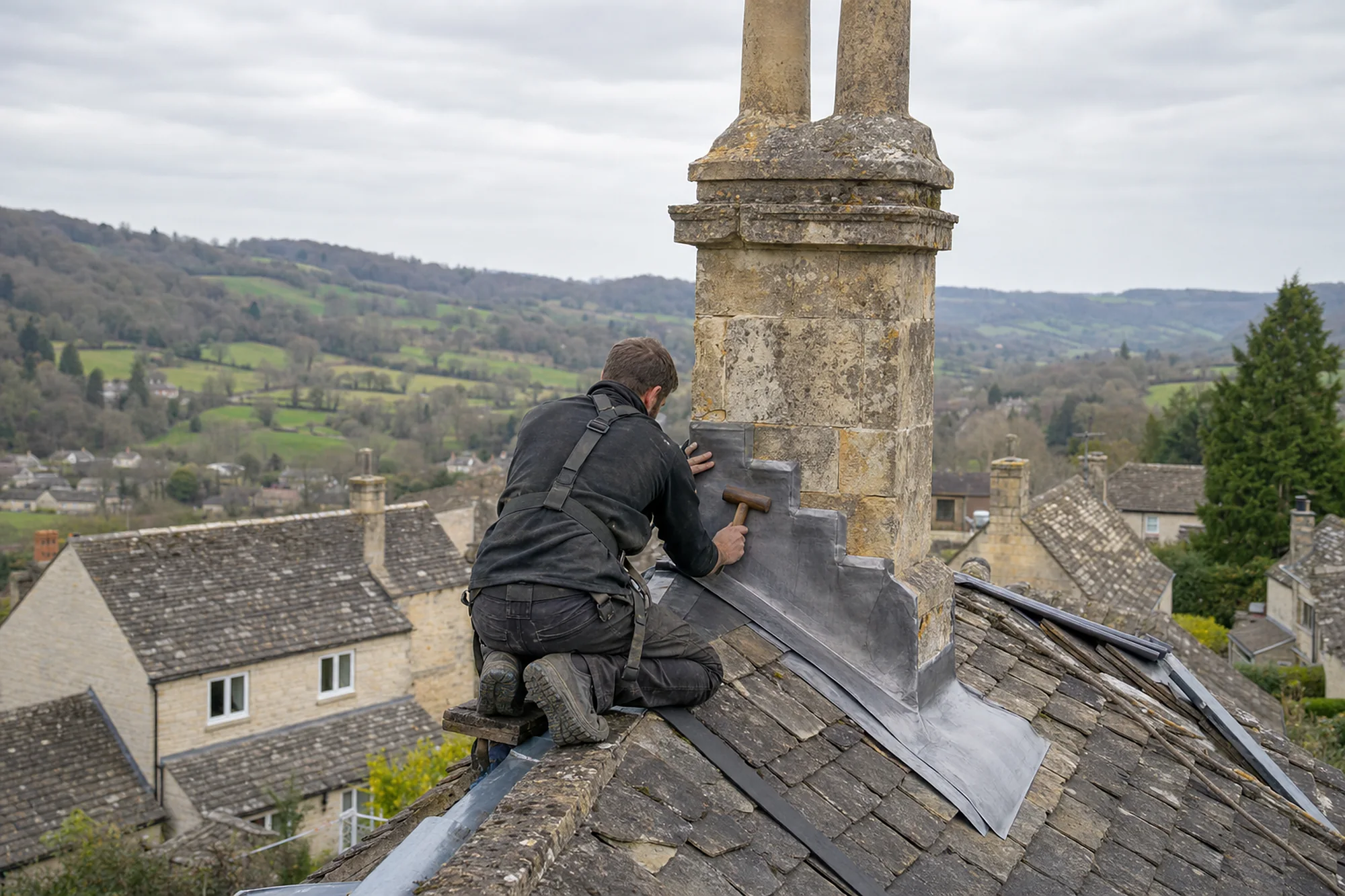
Bath stone, parapets and the lead that keeps water out of them
In a stone-built town, lead does the quiet work between roof and wall.
Chapter 01In this chapter
Corsham stands above the Bath stone mines, and the stone has shaped how buildings in the town are finished. Bath stone is a limestone, and it is cut and dressed for walls, window surrounds, chimney stacks and the copings that cap a parapet. Where the wall carries on above the eaves as a parapet, there is often a gutter tucked in behind it, lined with lead or another metal. That hidden channel is a classic spot for a stone building to start leaking.
Why lead? It can be dressed to follow the shape of the stonework, it lasts, and it is traditional. MyJobQuote reports flashing lasting over 80 years when it is installed correctly. Lead is sold by code, a number that stands for thickness. Code 4 is 1.80 mm thick, and Leadworx calls it the everyday choice for flashings. Code 5 is 2.24 mm and suits gutters and vertical work, while Code 6, at 2.65 mm, is used on larger roofs. Which one suits your building depends on the detail, and we state the code in the quote.
The usual faults are easy to describe. Thin lead can crack as it warms and cools. Lead fixed too tightly cannot move at all and splits at the bends. Pointing around a flashing may have crumbled, leaving a gap where water enters behind the lead. And a blocked outlet on a parapet gutter lets water back up and over the edge. Each one produces a damp patch on a wall or ceiling that can be some distance from the cause.
When we survey a stone building with parapets, we look at the gutter from above, check the outlets, and trace the lead along its length. We photograph the sections that are failing and mark which are worth repairing and which should be replaced. Typical national prices help you plan, and Checkatrade's repair guide lists lead flashing repairs at £50 to £70 per metre and stepped flashing at £80 to £120 per metre in Code 5, excluding VAT. Our lead roofing page sets out more of the ranges.
Where the parapet or the chimney stack also needs attention, we describe the masonry work separately so you can decide who should carry it out. A roofer's job stops at the roof.
Behind a parapet, stone and lead have to work as one.
| Code | Thickness | Typical use |
|---|---|---|
| Code 4 | 1.80 mm | General flashing work |
| Code 5 | 2.24 mm | Flashings, gutters and vertical work |
| Code 6 | 2.65 mm | Larger roofs and gutters |
Chapter 02
The so-called Flemish Weavers' Houses and a High Street of 60 listings
On a street this densely listed, the access plan and the consent plan come first.
Chapter 02In this chapter
Numbers 94 to 112 High Street, known as the Flemish Weavers' Houses, are Grade II* listed. There is little evidence that Flemish weavers ever lived in them, hence the so-called, but the listing itself is not in doubt. More than 60 buildings on the High Street are listed. A street like that is a working street too, with shops, offices and flats above them, and the roofs above the shopfronts are the ones that tenants and owners tend to forget until a stain appears.
The first question is always access. A building on a High Street usually has a pavement in front and a service lane or yard behind. Scaffold at the front needs the highway authority's licence and must leave the public a safe way past. Deliveries of materials are arranged around shop opening times, and waste is lowered and removed with as little disruption as possible. At the rear, a yard may be small or shared, so the plan covers where the skip can go and how the old covering reaches it. These details change the labour, and the labour shows in the written quote.
The second question is consent. Grade II* is a high grade, and for any listed building, changes to its character call for listed building consent, so expect the council to look closely. The conservation area adds its own scrutiny of what can be seen from the street. We propose like-for-like repairs and put them in writing, with photographs, so you can send them to Wiltshire Council's conservation team and ask for their view before anything is ordered.
The third question is who owns the roof. Above many shops the roof, the shopfront and the first-floor flat may belong to different people, and a roof leak may be a landlord's responsibility while the damage appears in a tenant's ceiling. For larger properties, our commercial roofing page explains how survey, quote and works are organised.
Corsham Court and St Bartholomew's show what long-lived roofs look like when they are kept up. Both have been altered across centuries, from the manor of 1582 to Street's restoration of the church between 1875 and 1878. Neither stayed the same, and neither was left alone. The point for an owner of any age of building is that roofs are maintained in cycles, and the least costly cycle is the one that begins before the leak.
It helps to document the roof before a problem arises. Photographs taken at survey, with dates and the written quote, give owners, tenants and agents the same information, and they save time if an insurer or a council officer asks questions later. They also make it easier to compare a repair price with a replacement price.
Chapter 03
From 3,754 to 9,268 people: the roofs of Corsham's mid-century growth
Fast building leaves a lot of roofs of the same age needing attention at the same time.
Chapter 03In this chapter
Corsham lies 28.7 road miles south of Stroud, and the town's population climbed from 3,754 in 1931 to 9,268 in 1951, a rise linked to military personnel. Houses built in a hurry for a growing town age together, and it helps to know what time does to roofs of that age.
A house put up in the 1930s or 1950s is now somewhere between seventy and ninety years old. Its first covering may have been replaced once already. Underlay from that era may be bitumen felt, and felt that has dried and cracked lets wind-blown rain through even when the tiles above look in order. Timber battens may have softened. Flat roofs on garages, porches and rear extensions may be on a second or third covering. EPDM, GRP and built-up felt each have their own typical lifespans: EPDM 20 to 30 years or more, GRP 25 to 40 years, and felt 10 to 20.
One older material needs a special mention. Garages and outbuildings of mid-century date sometimes have asbestos cement sheeting. On HSE's reading, lifting such sheets down with care and whole needs no licence, but heavy damage or breakage means notification has to precede the work. We leave the sheets alone until they have been assessed, after which the written quote sets out the method of removal, the disposal and the replacement roof. Our garage roof replacement page gives the typical national prices for the replacement.
Loft insulation is worth thinking about at the same time. The VAT position differs between the two. Insulation fitted in a home's loft or roof carries no VAT until 31 March 2027, but ordinary roofing work attracts the standard rate, and your quote will show the VAT. If you are re-roofing a house with a poorly insulated loft, it makes sense to talk through the two jobs together, because the roof is open and the cost of access is shared.
When many neighbouring houses have roofs of the same age, a group booking can reduce scaffold costs. We are glad to look at several roofs on one visit, with each owner's agreement, and to price each house on its own. Once the job is done we leave the site clear, take the waste, and put our ten-year workmanship guarantee on paper.
- 3,754Corsham's population in 1931
- 9,268Corsham's population in 1951, a rise linked to military personnel
- 1582date of the Elizabethan manor house on which Corsham Court is based
Map showing Corsham and the Stroud service radius, with nearby towns we also cover.
Near Corsham
Roof work we do here
Corsham Court, the High Street and Bath stone parapets
My Corsham house has a stone parapet with a lead gutter behind it. What do you inspect?
We check the outlets, the falls, the lead along its length, the joints at the corners and the pointing where the lead meets the stone. A cracked or tight lead lining is a common reason for damp inside the wall below, and every section is checked.
Can you work on a roof above a High Street shop in Corsham?
Yes. We plan scaffold, a highway licence where the pavement is used, delivery times and waste removal around the shop's hours, and put each of these in the written quote. Ownership of the roof should be settled before work begins.
Do Corsham's listed buildings need consent for a re-roof?
If the work reaches the building's character, Wiltshire Council's listed building consent applies. We start from a matching repair and suggest you confirm the position with the council's conservation team before materials are ordered.
My Corsham garage has a corrugated sheet roof that might be asbestos. What next?
Assessment comes first. HSE guidance says careful removal of sound sheets needs no licence, though substantial breakage means the work has to be notified. The quote then sets out method, disposal and the new covering.