
Roofers in Dymock
Dymock is a north Gloucestershire village near the Herefordshire border, with a Grade I church, a conservation area from 1989 and old houses the Dymock poets once lived in.
Dymock at a glance
- Distance
- 22.5 road miles north-north-west of Stroud
- Council
- Forest of Dean District Council
- Conservation area
- Dymock, designated 29 June 1989
- Listed
- Church of St Mary, Grade I
Dymock's old houses, church and canal-age buildings
Dymock sits in the north Gloucestershire countryside near the Herefordshire border, south of Ledbury, and 1,187 people lived in the parish at the 2021 count. It is a village that people come to see. Between 1911 and 1914 it was the home of the Dymock poets, and the homes of Wilfrid Wilson Gibson, Lascelles Abercrombie and Robert Frost can still be seen. Behind the literary story is a village of buildings from many centuries, and each one has a roof with its own needs.
St Mary's Church is of Anglo-Norman origins and is described as a patchwork history in brick and stone. Its listing is Grade I, which is the highest grade. The White House was the birthplace in 1637 of John Kyrle, the so-called Man of Ross. The village also has cruck-beam cottages, and each one's covering is identified at the survey.
The Hereford and Gloucester Canal ran through Dymock from 1845 to 1881, a span of 36 years, after which the stretch from Ledbury to Gloucester was turned into a railway. Dymock Conservation Area was designated on 29 June 1989, and Forest of Dean District Council is both the planning authority and the body to ask about any change to a roof's appearance.

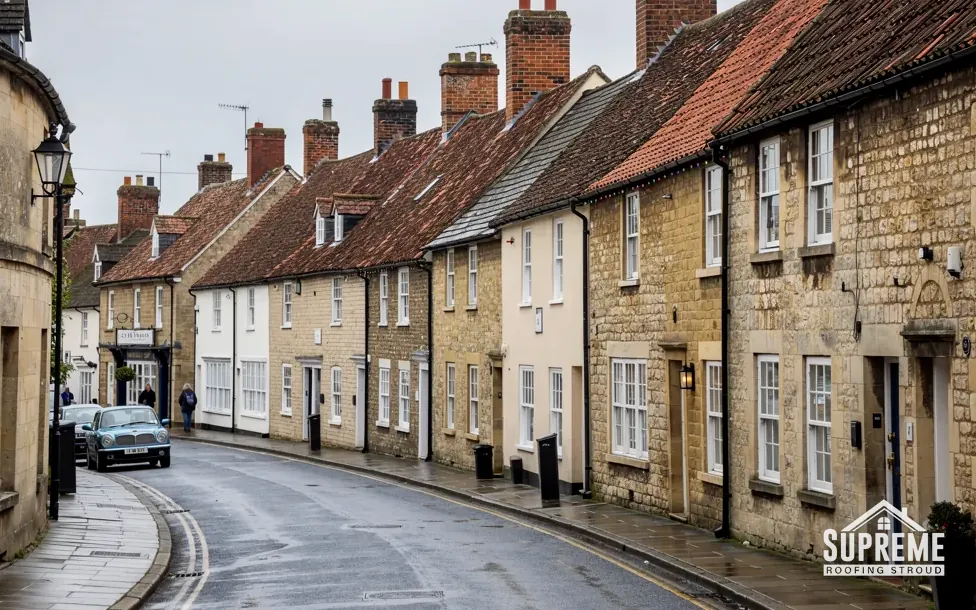
Victorian terraced houses with slate roofs and chimneys on a hillside 
Flint and brick cottage with a clay tile roof beside a road

Chapter 01
St Mary's, Grade I, and the Dymock Conservation Area
The village's best-known building is the benchmark for how carefully its roofs are treated.
Chapter 01In this chapter
A building described as a patchwork history in brick and stone has been repaired, rebuilt and extended in different materials over the centuries. That is a fair guide to how roofs behave in a village of this age. A repair in one decade is replaced by a different repair in the next, and a roof that looks uniform from the lane can contain several generations of work. Our first job at a Dymock survey is to read that history from the loft and from the eaves before deciding what to do. Different patches of tile, newer battens set beside weathered ones, a section of lead that does not match its neighbour: each is a clue to what was fixed, when, and how well.
In this chapter
Dymock Conservation Area was designated on 29 June 1989. A conservation area is a control on change, not a ban. Repairs that restore the existing covering are normally acceptable, and a re-roof in matching material does not usually need planning permission. If you want a different covering, a rooflight or a changed chimney, put that to the council's planning team before anything is ordered. Dormers are not permitted development in a conservation area, so a loft conversion that adds one needs a planning application.
St Mary's is still used for worship, so the ecclesiastical exemption applies and the parish seeks a diocesan faculty for any roof work. Houses nearby are another matter. A house that is listed in its own right goes to the council, and its owner needs listed building consent for work touching its character.
What a listed house needs on paper
If your house is listed, the protection covers the building as a whole, roof included, so the listing decides what paperwork comes before the scaffold. We ask early whether a house is listed, we record the existing roof thoroughly, and we describe any proposed work in terms the conservation officer can assess. A well-prepared description saves weeks on a consent.
Keeping the evidence
Whenever we strip an old roof, we photograph what comes off: the underlay if there is any, the battens, the timbers, the nails. That record helps with the paperwork, and it helps you if the building is ever sold or surveyed. A buyer's surveyor looking at a roof in a conservation area wants to know what was done, with what, and who did it, and a folder of dated photographs answers all three at once.
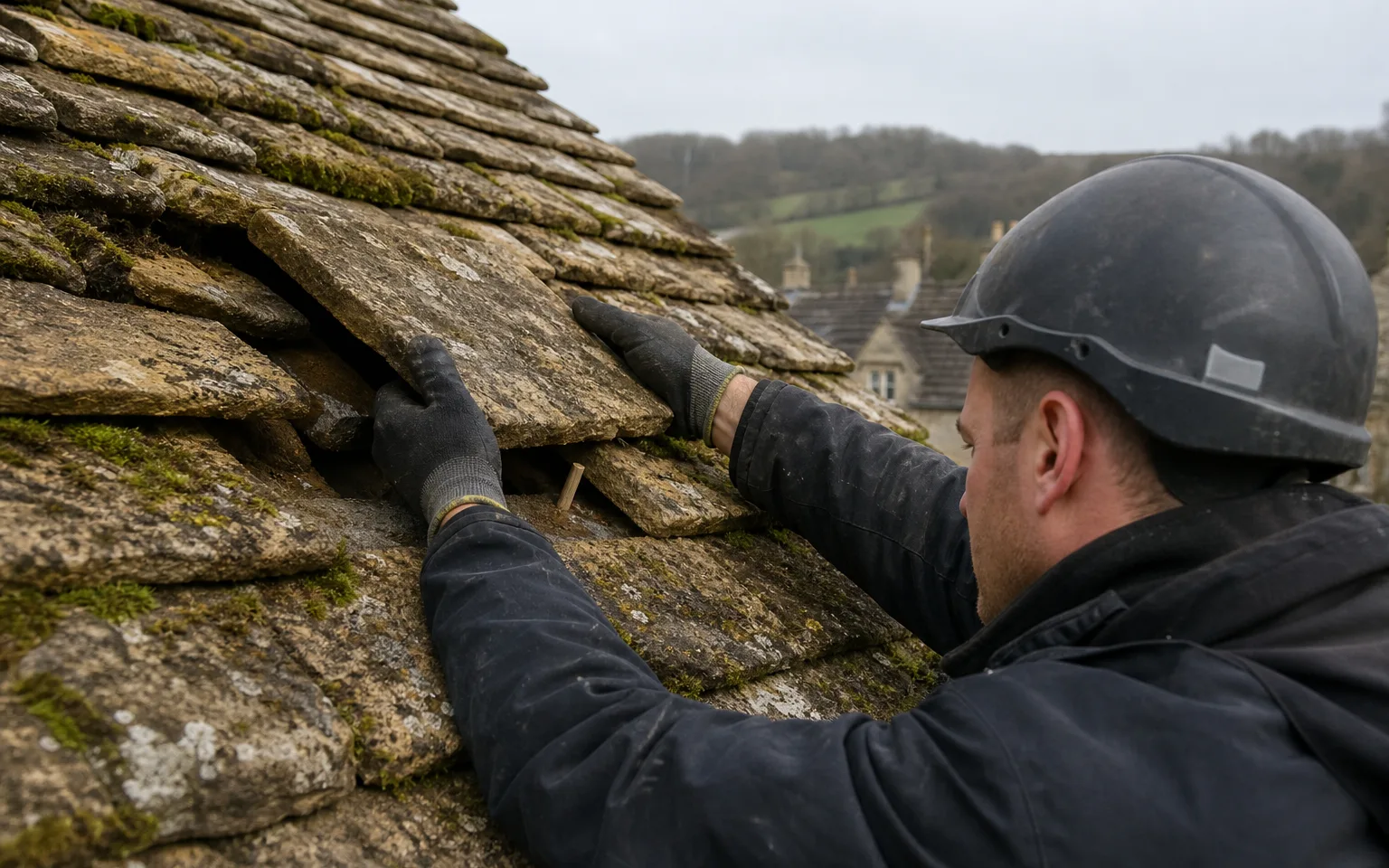
A roof in a village this old rarely has one date; our first job is to read all of them.
- Grade Ilisting for St Mary's Church, of Anglo-Norman origins
- 1989year Dymock Conservation Area was designated, on 29 June
- 1637year John Kyrle was born at The White House

Chapter 02
Cruck-beam cottages and the Dymock poets' homes
In an old frame, the roof timbers and the walls are one structure and must be repaired as one.
Chapter 02In this chapter
A cruck is a curved timber, used in pairs, that runs from low in the wall up to the ridge and leans in to meet its partner, forming an arch. Wikipedia notes cruck-beam cottages in Dymock. In a cruck building the main frame carries the weight of the roof straight to the ground, so the walls between the crucks may be infill instead of structure. That is the reverse of most modern houses, and it changes how a roof is repaired.
In this chapter
If the base of a cruck rots, the roof above it can sag, and the cause may be damp from a blocked gutter at the eaves instead of anything wrong with the covering. So when we survey a house of this type we look for the line of the roof against the sky, for any dip near the eaves, and for staining on the timbers inside. We tap suspect timbers, probe softened ones, and photograph them. It is a slow process, but a cruck roof does not forgive a hurried look, and an hour spent on the timbers at survey can save a second visit with a scaffold in place.
The poets' homes were ordinary village houses that became famous. Robert Frost, Lascelles Abercrombie and Wilfrid Wilson Gibson lived within reach of one another in 1911 to 1914, and the buildings can still be seen. If you own one, or a house like it, nothing about its fame changes the way water gets in. The same checks apply: the ridge, the valleys, the flashing around the stack and the gutters.
Like for like, in detail
On old houses we work like for like: stone stays stone, clay stays clay and slate stays slate. Profile, colour and size follow what is already on the roof, and where reclaimed material would suit, the quote names it. Our roof repairs page explains how we price a patch repair against a larger job.
When the roof is a landmark
A house that people visit has more eyes on its roof than most, and a roof that has been badly patched once tends to be patched again. A mismatched repair shows. The covering, ridge detail and verge treatment are agreed with you in advance, and we photograph the finished work from the lane so you have a record of how it looked.
Chapter 03
The canal years: houses from 1637 to the Victorian period
Four centuries of building in one village means four generations of roof to understand.
Chapter 03In this chapter
The Hereford and Gloucester Canal opened through Dymock in 1845 and closed in 1881. Those Victorian years sit more than two centuries after The White House was the birthplace of John Kyrle in 1637. Houses in Dymock were being built, altered and re-roofed across that whole period and after it, which means no single method fits the village.
In this chapter
A roof from the 17th century and a roof from the canal years behave differently. The older house may have a steep pitch, handmade coverings and timbers cut for the job, whereas a Victorian house is more likely to have a regular frame, sawn battens and a covering laid to a consistent gauge. The old house forgives an imperfect line; the newer one shows it. That is why a quote for a Victorian house assumes straight courses and tight laps, and a quote for an older one allows time for fitting each tile to the frame beneath it. So the first step in any quote is to work out which kind of roof you have, and the survey records the evidence for that.
Costs vary with the job, and MyBuilder's 2026 guide gives UK ranges to give a sense of scale: £150 to £1,500 on average for a roof repair, and £5,000 to £12,000 for a full re-roof. Those are national figures. The written quote that follows the survey replaces them with a price for your roof, covering every cost, from scaffold to waste disposal, in plain terms you can check. Our roof replacement page covers the stages of a full re-roof.
Moss and old coverings
Older coverings that have been left unattended gather moss, and the temptation is to blast it off. MyBuilder's cleaning guide cautions that a pressure wash may harm delicate tiles, and a hard jet on old clay or stone can strip the surface. Gentle manual scraping is kinder to the surface, and it is the method we prefer on coverings that have already lived a long time. The our roof cleaning and moss removal page compares the methods and their typical costs.
Reading the age of a roof
Nail types, batten widths, underlay and lead weights all date a repair. We use them to build a rough history, which tells us what has been done before and what is likely to fail next. On a house that has been in the same family or the same village for generations, there are often records, and we are glad to see them.
| Date | Event | Roof consequence |
|---|---|---|
| 1637 | John Kyrle born at The White House | Houses of this age may have timbers cut for the job |
| 1845 to 1881 | Hereford and Gloucester Canal open through Dymock | Victorian building often has a more regular frame |
| 1911 to 1914 | The Dymock poets in the village | Their homes can still be seen and still need maintenance |
| 1989 | Conservation area designated | Changes of material go to the council first |
Map showing Dymock and the Stroud service radius, with nearby towns we also cover.
Near Dymock
Roof work we do here
Dymock poets' houses and the 1989 conservation area
My Dymock cottage has curved timbers in the walls. Does that change how the roof is repaired?
Yes. Cruck-beam cottages carry the roof on a few main timbers that run from low in the wall to the ridge, so a damp foot can make the roof sag. We check the timbers and the gutters first and photograph what we find before suggesting any covering work.
Does the Dymock Conservation Area stop me from re-roofing?
No. Putting back the covering that is already there is normally acceptable, and Forest of Dean District Council's planning team can confirm what applies to your house. A different material, a new rooflight or a changed chimney should be checked with them first.
Who approves roof repairs to St Mary's Church?
The church is still in use, which puts it under the ecclesiastical exemption: a faculty from the diocese is the route, applied for by the parish. We can provide photographs and a plain written description of the fault to support it.
Can a pressure washer clear moss from an old tiled roof?
It risks damage. MyBuilder cautions that a pressure wash may harm delicate tiles, and aged clay or stone can lose its surface under a hard jet. We usually recommend gentle manual scraping or a soft treatment, and we explain the options in the quote.